

How Labour Lost a Landslide in Record Time
Or: The Adults Were Back in Charge

When Keir Starmer became Prime Minister in July 2024, Britain was promised stability.
The adults were back in charge.
The chaos was over.
The grown-ups had arrived.
The era of sensible government had finally begun.
Two years later Starmer was standing outside Number 10 fighting back tears whilst his own MPs searched desperately for somebody else to lead them.
It was a remarkable achievement.
Not the election victory.
The destruction of it.
Political parties normally spend years slowly losing public trust. Labour approached the challenge with the enthusiasm of a Formula One driver attempting to break a land-speed record.
A 412-seat majority.
Gone.
Public goodwill.
Gone.
Authority.
Gone.
Confidence.
Somewhere underneath the wreckage.
Future historians will spend decades studying how a government inherited one of the strongest positions in modern British political history and somehow transformed it into a cautionary tale.
Fortunately Labour left detailed notes.
Chapter One: Let’s Freeze the Pensioners
Every government has a defining early decision.
Some launch major national projects.
Some cut taxes.
Some build houses.
Labour looked around Britain and concluded the most urgent issue facing the nation was that too many pensioners could still afford to turn their heating on.
The adults were back in charge.
Rachel Reeves unveiled plans to remove winter fuel payments from millions of elderly people.
The public reaction was immediate.
Poll ratings began falling faster than a piano dropped from a tenth-floor window.
Labour MPs started panicking.
Reform UK started celebrating.
The government insisted this was an example of fiscal responsibility.
Voters concluded it was an example of losing touch with reality.
The adults were back in charge.
Unfortunately, so were their ideas.
Chapter Two: Taxing Job Creation
Having dealt decisively with pensioners, Labour turned its attention to employment.
National Insurance was increased.
Thresholds were lowered.
Businesses complained.
Jobs disappeared.
Young workers were hit particularly hard.
The government described the policy as necessary medicine.
This was true in the same sense that being hit repeatedly with a shovel can technically be described as physical therapy.
The adults were back in charge.
Unfortunately unemployment seemed eager to join them.
Businesses warned about the consequences.
Economists raised concerns.
Warning lights flashed everywhere.
Labour’s response was to stare directly at the dashboard and continue driving.
The captain of the Titanic displayed greater curiosity about icebergs.
Chapter Three: Peter Mandelson Returns From the Political Afterlife
At some point somebody inside Downing Street apparently asked:
“How do we demonstrate we’re a fresh start?”
After a period of intense reflection, the answer arrived.
Peter Mandelson.
Nothing says change quite like reassembling the cast of a government from a quarter-century ago.
Security concerns were reportedly raised.
These concerns were examined carefully.
Then ignored with admirable efficiency.
The adults were back in charge.
And they had apparently mistaken a warning label for a recommendation.
Months later the appointment exploded into controversy exactly as critics had predicted.
Ministers reacted with genuine surprise.
This is one of the more impressive achievements of the Starmer era.
Being shocked by consequences everyone else saw coming.
Chapter Four: Out-Reforming Reform
Then came immigration.
Labour’s strategy appeared elegantly simple.
If Reform UK is gaining support, why not become Reform UK?
The adults were back in charge.
Speeches became tougher.
Policies became tougher.
Restrictions became tougher.
Numbers fell.
Targets were supposedly met.
And absolutely none of it delivered the political reward Labour expected.
The people who wanted Reform continued voting Reform.
The people who wanted Labour started wondering where Labour had gone.
It was rather like opening a steakhouse in an attempt to convince vegetarians that you’ve remained committed to their values.
The adults reassured everyone they knew exactly what they were doing.
This reassurance was becoming less reassuring with each passing month.
Chapter Five: The Polling Apocalypse
By late 2025 the opinion polls looked less like political data and more like a medical emergency.
Approval ratings collapsed.
Election results deteriorated.
By-elections became public executions.
Labour MPs began discussing government policy with the enthusiasm usually associated with root canal surgery.
The adults were back in charge.
Britain was beginning to suspect this might be the problem.
Then came the local elections.
Labour was demolished.
Not beaten.
Not defeated.
Demolished.
Reform surged.
The Greens surged.
The Liberal Democrats surged.
At one point Labour appeared to be competing aggressively for fourth place.
A governing party with a huge parliamentary majority had somehow convinced much of the electorate that literally anybody else might be worth a try.
That requires a level of dedication rarely seen outside elite sport.
Chapter Six: Everybody Heads for the Lifeboats
The resignations began.
Advisers departed.
Officials departed.
Senior figures quietly began updating their CVs.
The atmosphere inside government reportedly resembled the final act of a disaster movie.
The adults were back in charge.
Most of them were now heading for the exits.
Then attention turned to Andy Burnham.
Suddenly Labour MPs discovered an astonishing possibility.
Perhaps somebody else could lead the party.
A revelation roughly equivalent to discovering water whilst standing next to a lake.
Burnham won convincingly.
The contrast was painful.
One looked capable of defeating Reform to the Labour Party.
The other looked capable of losing an argument with a self-service checkout machine.
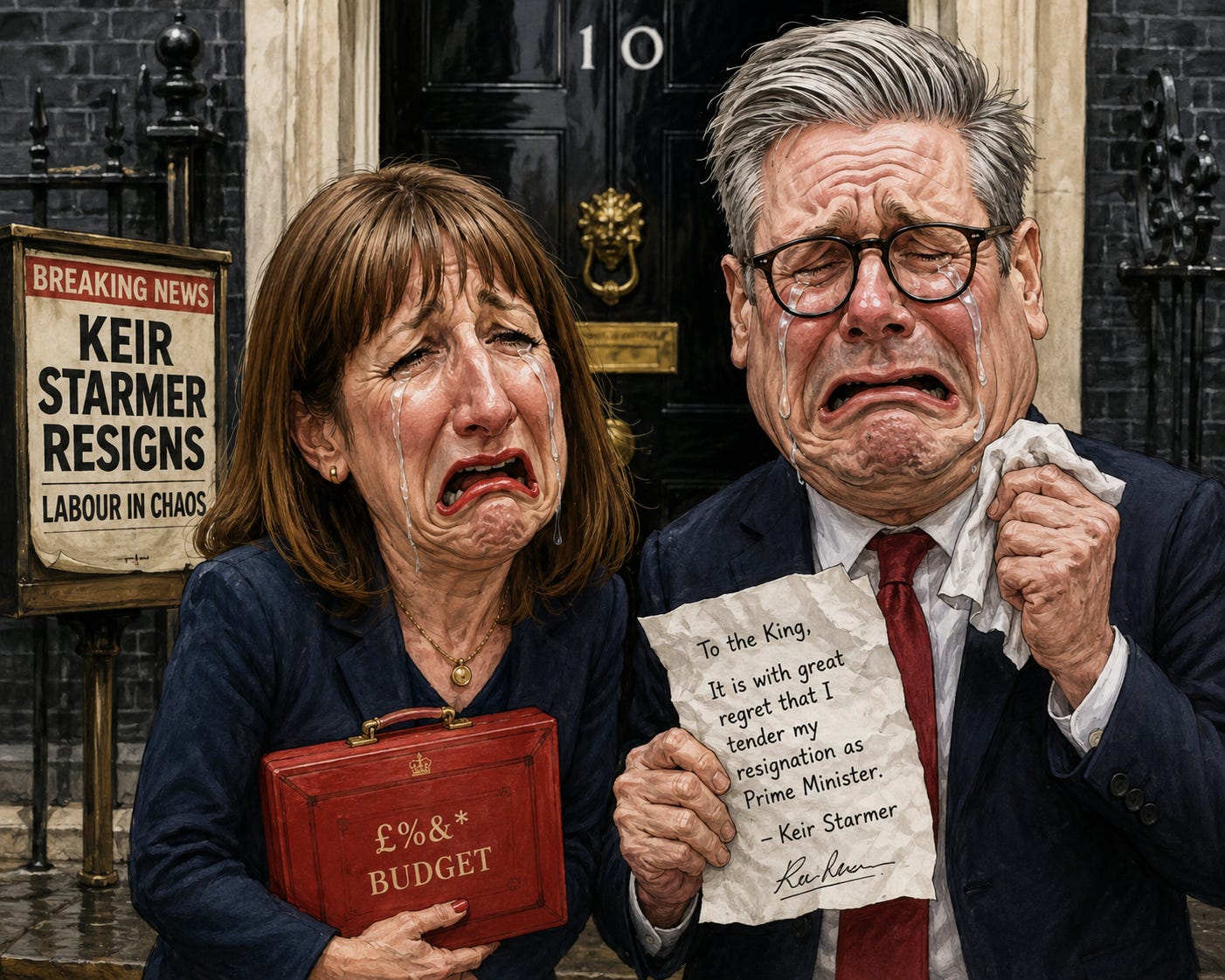
The End
And so we arrive at June 2026.
Keir Starmer stood outside Number 10 and announced his resignation.
He spoke about listening.
He spoke about duty.
He spoke about accepting the will of his parliamentary party.
What he did not explain was how a government that inherited almost everything managed to lose almost everything.
Labour inherited fourteen years of Conservative failure.
A massive majority.
A divided opposition.
A public desperate for change.
And yet somehow managed to transform one of the safest political positions in modern British history into a survival situation.
It is genuinely difficult.
You would almost have to try.
Historians will debate where it all went wrong.
Winter fuel.
National Insurance.
Immigration.
Mandelson.
The local elections.
The resignations.
The answer is probably all of them.
Because this was never one mistake.
It was a collection of mistakes so large it eventually became a governing philosophy.
The philosophy appeared to be:
“The adults are back in charge.”
Repeat as necessary.
Ignore results.
The adults were back in charge.
The pensioners were furious.
The businesses were furious.
Large sections of Labour were furious.
Even some of the adults appeared furious.
The only people genuinely enjoying themselves were Reform UK.
As political experiments go, it was certainly memorable.
The adults were back in charge.
And Britain learned an important lesson.
Always ask to see the qualifications.
Independent political analysis takes time and resources. To keep these articles free and accessible to everyone rather than locked behind a paywall, I rely entirely on voluntary reader support. If you value this work, please consider dropping a quick one-off tip in the coffee jar.
Part Two of Manufactured Consent: The Architecture Behind Britain’s Rape Gang Cover-Up should publish tomorrow or possibly Wednesday delayed a day or two by Keir Starmer’s resignation.
Agreed - you could have added the Chagos surrender, ruining the special relationship with the USA, digital IDs/social media bans too and other things I've probably forgotten - it goes on and on.......
He’s a Fabian - say no more! 😡