

The Lie The Establishment Will Now Tell You About Thursday

1,400 council seats, thirteen councils, and the realignment Westminster cannot bring itself to name
On Thursday, voters in 136 English councils were asked who should run their local authorities for the next four years. By Friday morning, Reform UK — a party founded in 2018, not yet six years old, and dismissed by every legacy commentator and pollster of consequence as a passing protest movement — had taken close to 1,400 council seats and seized thirteen councils outright. Labour had shed more than 1,300 councillors and lost control of over thirty authorities. The Conservatives had been turfed out of Essex, a county they had run for a quarter of a century, and humiliated across the rural shires they used to count on as a birthright.
You might think this would prompt an honest moment of reflection from the political and media class. You might think the BBC and the Guardian would lead, plainly and without softening, with the most striking realignment of the British vote in modern political memory. You might think the Conservative leadership and the Labour government would, at last, abandon the comforting fiction that this is all just temporary turbulence and that the country will, in the fullness of time, settle obediently back down.
You would be wrong on all three counts.
What you will get instead is the same ritualised performance the establishment has reached for at every previous Reform high point. The same vocabulary. The same patient, slightly pitying explanations to voters about what they were “really” trying to say. The same knowing references to “protest votes” and “voter discontent” and prime ministers who must “listen and learn”. The article that gets written at the BBC, the Guardian and the Times this weekend has, in essence, been written four times already in the last three years. They will repeat it because they have nothing else to say — and because saying anything else would mean conceding what they cannot afford to concede.
What Actually Happened
Let us deal first with the facts, since the establishment press already seems determined to soften them.
Reform UK won roughly 1,400 council seats. The party took control of thirteen councils outright, including Essex — held by the Conservatives for twenty-five years and the local authority encompassing Kemi Badenoch’s own constituency — Suffolk, Sunderland, Newcastle-under-Lyme, and Havering — Reform’s first London borough.
Labour shed more than 1,300 councillors and lost more than thirty councils. The Conservatives lost six councils and several hundred councillors of their own on top. The Sky News National Equivalent Vote put Reform on 27 per cent, the Conservatives on 20 per cent, and Labour on a derisory 15 per cent — fifth, on some calculations, behind both the Greens and the Liberal Democrats.
Apply Thursday’s vote share to the House of Commons and the result is more striking still: 284 seats for Reform UK, 110 for Labour, 96 for the Conservatives. That is not a prediction. Local elections never translate cleanly to a general election, and any commentator selling that figure as a forecast is either misunderstanding what he is reading or hoping you will. But it is, by some distance, the largest projected lead any non-legacy party has held over either Labour or the Conservatives in modern British political history.
The individual results carry the story even more sharply than the totals. In Hartlepool, the wife of a sitting Labour MP lost her council seat to Reform — in the very town her husband represents in Parliament. In Camden, the Labour council leader was unseated by the Greens, in the borough that takes in Sir Keir Starmer’s own Holborn and St Pancras constituency. In Manchester, where Labour suffered what one of its veteran MPs publicly described as the party’s worst result in sixty years, calls from Labour’s own MPs for Sir Keir’s resignation were on the record before Friday lunchtime.
So far, unprecedented. And yet, by Friday afternoon, the Westminster line was already forming. The same line we have heard at every Reform threshold for five years. A “warning shot.” A “protest vote.” A “wake-up call.” Voters letting off steam who will, in the fullness of time, come home.
That line is the lie. Let me explain why.
The Lie They Will Tell You
The “protest vote” framing is not a piece of analysis. It is a coping mechanism. It is what the political and media class reach for when an electoral result tells them something they do not want to hear. It allows them to acknowledge the numbers while preserving their assumptions. It allows them to say “the voters are angry” without ever having to ask the more uncomfortable question of whether the voters might in fact be right.
You can dismiss as a protest a single by-election shock. You can dismiss as a protest a poll lead.. You cannot dismiss as a protest the simultaneous seizure of Essex, Suffolk, Sunderland, Havering and Newcastle-under-Lyme on a single night. You cannot dismiss as a protest the loss of a Camden council seat in the Prime Minister’s own borough. You cannot dismiss as a protest a National Equivalent Vote of 27 per cent — a clear lead over both legacy parties for the first time in a hundred years.
What we saw on Thursday was not the electorate sending a message it expects the establishment to absorb. It was the electorate delivering a verdict it expects the establishment to obey. There is a meaningful difference. The first is a tantrum. The second is a sentencing.
What I think the political class has not yet absorbed — and what makes this set of results different in kind, not merely in scale, from previous Reform high points — is the geographic distribution of the vote. That is the thing that should have changed every assumption in every Westminster strategy room over the weekend. And it is, of course, the thing they will spend the next fortnight working hardest not to discuss.
The Map That Cannot Be Explained Away
For the last decade, those of us arguing that the country wanted something different from what the two main parties were offering were patiently informed — usually by people whose tone made clear they thought we did not understand the British constitution — that our electoral system would not allow it. First past the post would crush any insurgent party. They might pile up fifteen per cent of the national vote, but they would never translate it into seats. The system was designed to protect the duopoly. The system would hold.
The system did not hold. Reform’s vote on Thursday was not piled up uselessly in a few angry towns. It was distributed across the country in precisely the way that translates, under our voting system, into actual seats and actual majorities.
Look at where Reform won. Essex: a Tory shire bastion and the local authority of the Conservative leader. Suffolk: another rural Conservative heartland, lost. Sunderland: a Labour stronghold containing the Westminster seat of the Education Secretary, Bridget Phillipson, no less. Havering: in outer London, supposedly the impregnable territory of progressive politics, and now Reform’s first London borough. Newcastle-under-Lyme: a Midlands battleground that has decisively broken with both legacy parties at once.
This is not a regional story. This is not a Red Wall story or a Blue Wall story or any of the other convenient phrases the political correspondents use to make the country sound smaller and more manageable than it is. It is a national story. The North turned out for Reform on Thursday; so did the rural shires that have spent a hundred years returning Conservatives. Post-industrial towns and market towns voted the same way. Outer London now sends Reform a borough.
Nigel Farage, on Friday morning, called Reform “the most national of all parties”. For once, the rhetoric was not running ahead of the reality. The legacy parties have fortresses now. Reform has a country.
Why The Establishment Cannot Admit It
Let us be direct about this, because the British public deserves directness.
The mainstream media in this country — the BBC, ITV, Channel 4, the Guardian, the Independent, and to a considerable extent even the Times — will spend the next fortnight rationalising Thursday’s result rather than reporting it. They will reach, almost reflexively, for the language of voter protest. They will commission columns from old Labour hands and Tory grandees explaining why the public has not really meant any of it and will think better of it before the next general election.
They will do this because the alternative is unthinkable to them. To accept what Thursday showed is to accept that the political world they have spent their careers reporting on, defending, and quietly belonging to is breaking apart in front of them. It is to accept that the “responsible” politics they have championed for a generation has been comprehensively rejected by the public it claims to serve. It is to accept that voters they have spent a decade describing as ill-informed, racist, deluded, or angry have in fact been reading the country more accurately than the people paid to do so for a living.
These are organisations whose senior editorial staff are overwhelmingly drawn from the same universities, the same London postcodes, the same ideological ecosystem. They are not, when it comes down to it, willing to write the article that admits you were right and they were wrong. So the article they write instead is the one about a “warning shot.” About “voter discontent.” About a Prime Minister who must “listen and learn.” The same article they wrote after every Reform breakthrough since 2021. They will keep writing it until they cannot.
What I Think Comes Next
It is tempting, on a morning like this, to celebrate. The bigger task is to consolidate. Three things will determine whether Thursday’s vote translates into a Reform government at the next general election, and Reform’s leadership will know it.
First, the councils that have just changed hands must be governed well. Voters who have made a historic break with their old loyalties will not give a second mandate to a party that takes their council and runs it badly. Council tax bills, bin collections, planning applications, social care — the unglamorous machinery has to work. Every Reform-run authority that delivers becomes a live argument for a Reform government. Every one that stumbles becomes a stick the establishment press will use against the party for the next eighteen months and beyond.
Second, the discipline of message must hold. The legacy parties’ last hope — the one being whispered in private by Labour and Conservative strategists who could not stop this on Thursday — is that Reform fragments. That ego, defection and infighting will achieve what voters refused to deliver. The next eighteen months will test internal cohesion as severely as they test policy.
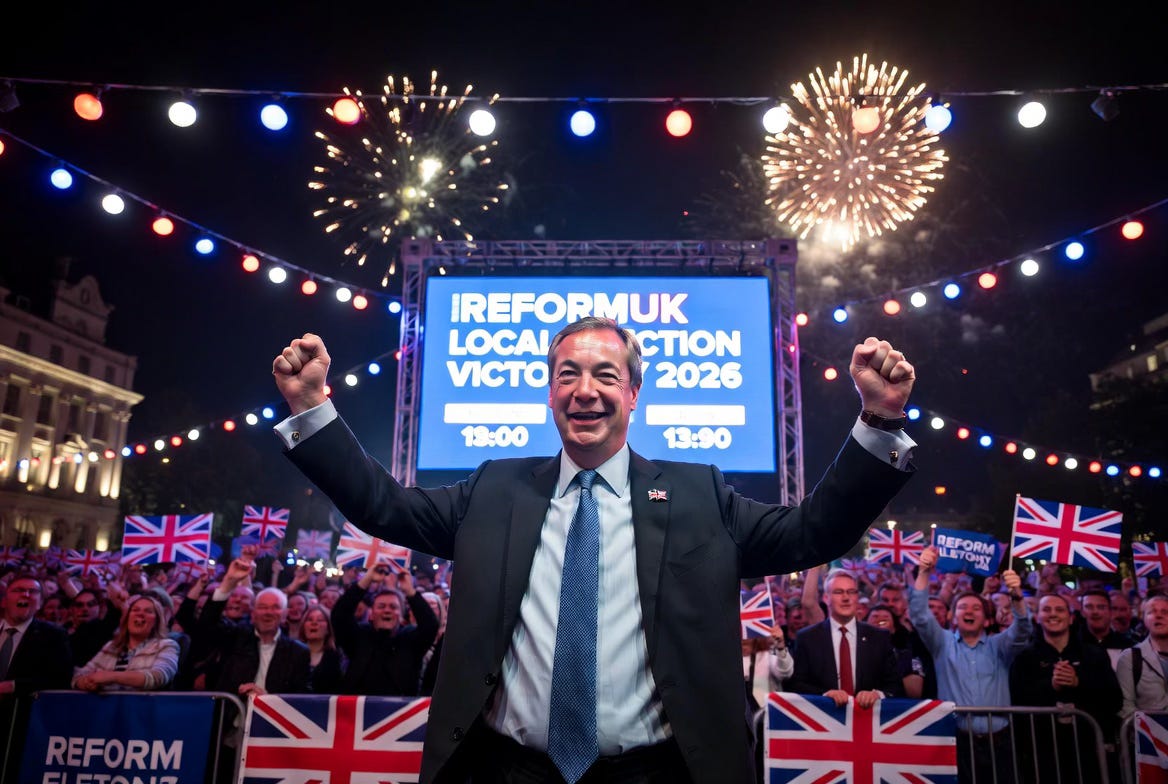
Third, and most easily forgotten: the case must keep being made. Voters who have just realigned do not need to be courted. They need to be reassured that they were right. The job is not done on election night. The job is the conversation that comes after — the patient, repeated explanation of why the country can do better, why the old assumptions failed, and why what happened on Thursday is not an experiment but a correction
.
What Thursday Actually Was
Sir Keir Starmer, in a brief and visibly chastened press appearance on Friday, told the Labour faithful that he was not going to “sugarcoat” the results. He then attempted, with some care, to do precisely that. The country’s mood, he said, reflected a public that wanted “faster change”. His administration had heard the message. Lessons would be learned.
This is the same Sir Keir Starmer in whose own borough the Labour council leader has just been removed by the voters. This is the same Sir Keir Starmer whose Education Secretary’s home council has just fallen to Reform. This is the same Sir Keir Starmer whose own veteran MPs spent Friday morning publicly demanding his resignation.
The pretence that this was a verdict on “the pace of change” rather than a verdict on him personally is not going to hold. It is not even meant to hold. It is meant only to last long enough for him to get through this weekend and into next week’s news cycle, where some other story can be relied on to absorb the establishment’s attention.
What I can tell you is this. Thursday was not a swing. It was not a protest. It was not a warning. It was a settlement. A country looked at the parties that have governed it, in both colours, for the better part of a century, and delivered a verdict the establishment will spend the next month trying to rephrase, reframe, and explain away.
They will not succeed. The general election is now Reform UK’s to lose. The job between now and then is, quite simply, not to lose it.
The establishment will tell you Thursday meant something else. It did not. It meant what it said. And it is the kind of verdict no amount of metropolitan spin can ever quite undo.
sources include: Local Government Chronicle live blog ITV News election results page Wikipedia
If a few more readers become paid subscribers, Inside Britain can chase the stories the BBC won't touch, put the questions Downing Street is hoping nobody asks, and keep writing the kind of plain, unfiltered political analysis you no longer get from the legacy press. If you can afford it, please support the work.
Prefer a one-off contribution? You can buy me a coffee.
Great stuff. What I'm noticing is commentators likening Reform to UKIP who surged and fell away. Inferring a flash in the pan protest. The fact is UKIP turned into the Brexit Party and delivered the biggest political earthquake in British political history, Brexit. Farage’s credentials should be measured by that operation. People are trusting Reform UK to turn the country around. They see nobody else who can do it. I saw that leftist twit Jim Dale on talk this morning activating his coping mechanism, “only 26% voted Reform so 74% didn't vote for them”. Thats such a retarded view of the situation and a massive exercise in gaslighting. These elections show Reform UK is now a trusted and electable party with a rock solid base. It wasn't a rejection of Keir Starmer, or even the Labour Party but the entire political establishment.
Reform UK won more than 1420 or so council seats, they won credibility and gravitas. This was a big step forward. It now gives voters the confidence to go and support Reform, they have become the biggest party in Britain today.
I have zero doubt that come a general election voters will choose Reform over the Con-Lab uniparty. Not as a protest, but as a rejection. And as an overwhelming desire to bring Britain back to being great again.
Brilliant article here!!! You really explained some difficult facts and results beautifully! You have articulated the situation and more importantly what needs to be done going forward! Well said, and well done!!! Thanks for this! 👍