

The Starmer Arson Trial No One Is Covering

When the arrests were first made public in May 2025, nobody knew the full picture. The press wasn't asking questions, Downing Street wasn't offering answers, and what little information existed was fragmentary, speculative, and contested. This publication, like others, worked with what was available and asked the questions the mainstream media would not. Now, two weeks into the trial at the Old Bailey, the prosecution has laid its case before a jury — and the picture that has emerged in open court is far more serious, far more disturbing, and far more consequential than almost anyone anticipated.
Someone tried to burn down the Prime Minister’s house. Not a metaphor. Not a figure of speech deployed by a Labour backbencher at a fringe event. In May 2025, three men — recruited on Telegram by a Russian-speaking handler, paid in cryptocurrency, and given operational codewords to use if arrested — allegedly set fire to a car previously owned by Sir Keir Starmer, then to a property linked to him, and then, on the third night, to the front door of the house where his sister-in-law and her daughter were sleeping. Judith Alexander told the Old Bailey she woke to a noise like two wheelie bins thrown at the door, saw smoke and an orange glow, and grabbed fire masks for the family while calling her sister Victoria — the Prime Minister’s wife.
You might think this would be the biggest criminal trial in Britain right now. You might think the BBC would be running a live blog from Court 2 of the Central Criminal Court, that the Times and the Telegraph would have their best court correspondents filing daily, that the Guardian would be producing the kind of long, anxious commentary it reserves for any event that touches the integrity of the democratic state. You might think that an alleged foreign-directed arson attack on the home of a sitting Prime Minister — involving a handler who communicated in Russian, used the duress codeword “geranium,” and instructed his recruits to delete their data and leave the city — would, at the very least, make the front page.
You would be wrong.
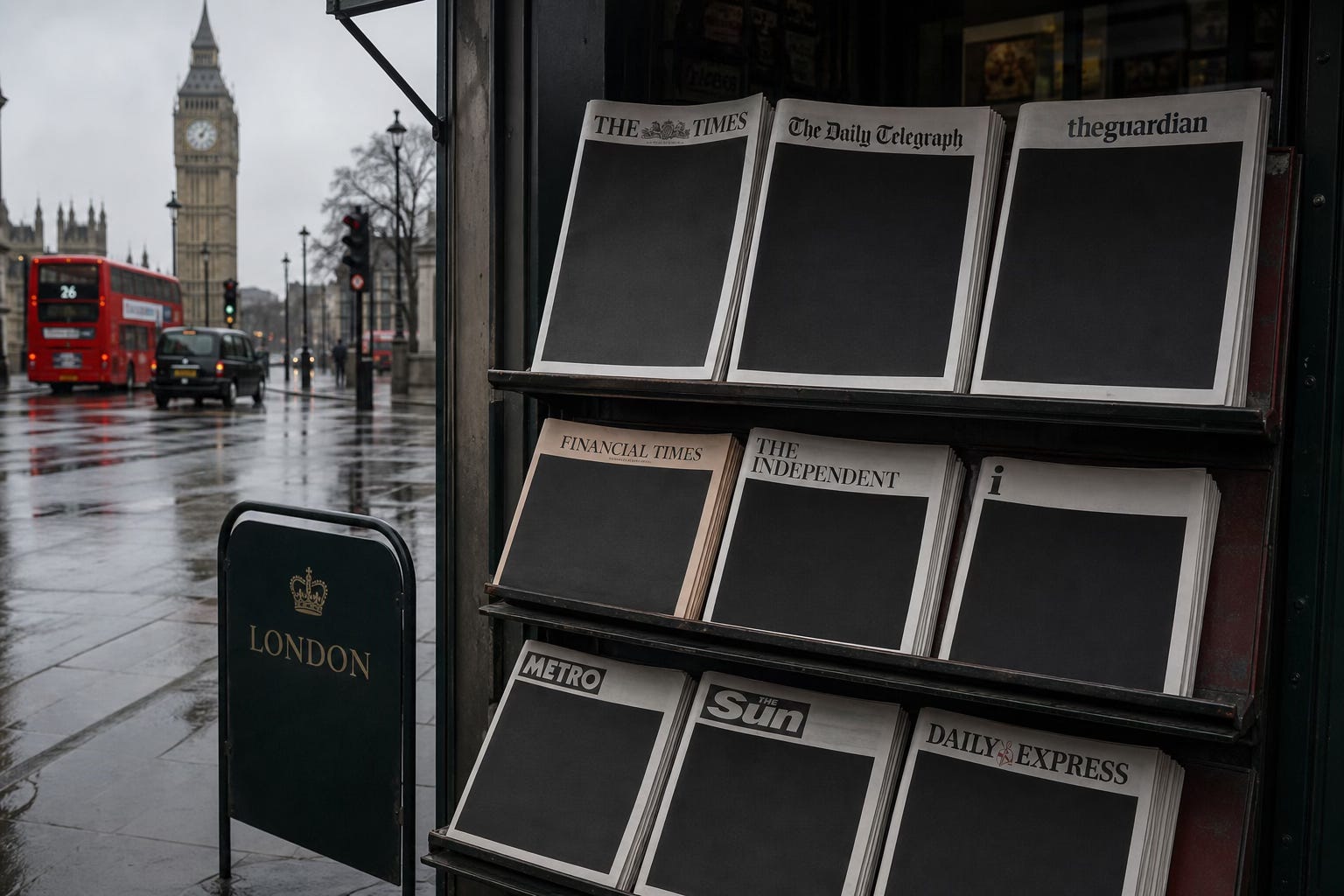
The trial of Roman Lavrynovych, Petro Pochynok and Stanislav Carpiuc opened at the Old Bailey on 27 April 2026. It has been running for over two weeks. It is being heard before Mr Justice Garnham in Court 2. There are no special reporting restrictions. No DSMA notice — formerly known as a D-notice — has been issued. The press gallery is, in the most literal sense, open. And yet the major newsrooms of Britain have, by and large, decided that this trial is not worth covering.
What coverage exists has come from the Press Association wire — syndicated to regional papers like the Hexham Courant, the Sudbury Mercury and the Whitehaven News — and from ITV News, LBC, Bloomberg and a handful of independent outlets, most consistently Labour Heartlands, whose editor Paul Knaggs has been filing daily from the courtroom. The BBC has not run sustained gallery coverage. The Mail has not led with it. GB News, for all its appetite for stories that embarrass the establishment, has been largely silent. The contrast with the Dylan Earl trial — an operationally near-identical case, covered extensively by every major broadcaster — is not subtle. It is glaring.
That is the first thing that needs saying. Here is the second.
El Money, 320 Telegram Messages, and the Motive the Old Bailey Jury Cannot Hear
Let us deal with the facts of the prosecution, since they are more extraordinary than most of the country has been allowed to realise.
The Crown’s case, led by Duncan Atkinson KC, is built on digital forensics, location data, CCTV and approximately 320 Telegram messages between the lead defendant, Lavrynovych, and a contact known only as “El Money.” The handler communicated in Russian. The defendants otherwise spoke Ukrainian. The relationship began months before the fires, with low-level paid tasks — putting up posters, spraying graffiti. One of the earlier jobs, according to Lavrynovych’s own evidence, involved defacing an Islamic community centre in south London. Another involved anti-mosque posters in Southall, which Lavrynovych says he abandoned because he suspected it was propaganda. Digital evidence recovered from co-defendant Carpiuc’s phone reportedly included images of four Islamic centres sent by the same handler.
Then the tasks escalated. El Money allegedly offered Lavrynovych between two and three thousand pounds in cryptocurrency — the figure varies depending on the source, with some court reports citing £3,000 and others £2,000 — to set fire to a Toyota RAV4 previously owned by the Prime Minister. Pochynok was allegedly tasked with filming. Carpiuc allegedly handled communications about payment. When Lavrynovych complained that the resulting two-second video did not show the fire well enough and that he had not been paid, the handler allegedly pushed for more. Two further arsons followed in quick succession — the Ellington Street property and then Starmer’s former family home in Kentish Town.
After the third fire, the prosecution says, El Money told the men they had attacked “a home of a very high-ranking individual in Britain.” He told them to leave the city. He told them to delete their data. And he gave them a word to use if they were detained by police: “geranium.”
This is not the vocabulary of opportunistic street crime. This is the operational grammar of a handled covert operation — recruitment through diaspora job groups, escalation from low-level provocation to high-value targeting, cryptocurrency payment, proof-of-work videos, duress codewords, and a handler who has never been identified, never been charged, and is not in the dock. Counter Terrorism Policing London ran the investigation. All three defendants have been held on remand at HMP Belmarsh — Britain’s highest-security prison, reserved for terrorism and the most serious organised crime cases.
And yet the charges on the indictment are not terrorism charges. They are not espionage charges. They are not offences under the National Security Act 2023. They are aggravated arson under the Criminal Damage Act 1971. Serious, certainly — the maximum sentence is life imprisonment. But the statutory framing tells its own story, because it is the framing that determines what the jury is permitted to consider.
Which brings us to the most remarkable feature of this trial.
Duncan Atkinson KC has explicitly directed the jury that it is “no part of their considerations” to determine who El Money is, or what reason he might have had to target properties associated with the Prime Minister. The judge, at an earlier hearing, described the circumstances as “somewhat opaque.” Court documents reportedly characterise the motive as “unexplained.” The prosecution is, in effect, asking twelve citizens to decide whether these three men set fire to the Prime Minister’s home — while formally instructing them not to ask why.
Now, lawyers will tell you that in strict legal terms, the prosecution does not have to prove motive. It has to prove that the defendant did it and that he intended to endanger life — but not why he did it. That is technically correct. It is also, in any practical sense, absurd. In every serious criminal trial, prosecutors give the jury a reason. He did it for the money. He did it for revenge. He did it because someone paid him to. Juries are not legal machines. They are twelve ordinary people, and ordinary people need the story to make sense before they can decide what they believe. Prosecutors know this, which is why they almost always provide a motive — not because the law demands it, but because the jury does.
So when a prosecutor does the opposite — when he stands up in open court and tells the jury that working out why someone allegedly firebombed the Prime Minister’s family home is formally none of their business — that is not routine. That is a choice. And the only reason to make that choice is if the “why” leads somewhere the prosecution, or the people above the prosecution, do not want this trial to go.
This is a case in which the Prime Minister’s sister-in-law told a jury that her family nearly died. A case involving a Russian-speaking handler using methods indistinguishable from those MI5 Director General Ken McCallum publicly warned about in October 2024, when he said Russia was on “a mission to generate mayhem on British and European streets.” A case that fits, almost perfectly, the pattern documented by Radio Free Europe / Radio Liberty, the Organised Crime and Corruption Reporting Project, and Ukraine’s own Security Service — Russian intelligence using Ukrainian-speaking migrants in Western European job groups as disposable proxies for sabotage and provocation.
And the jury has been told, in terms, not to think about any of that.
Dylan Earl Was Charged Under the National Security Act — Why Wasn't the Starmer Arson Case?
To understand how unusual this is, you need only look at what happened at the same court, seven months earlier.
In October 2025, Dylan Earl was sentenced at the Old Bailey to seventeen years for organising an arson attack on a London warehouse containing Starlink equipment destined for Ukraine. The recruitment method was near-identical: a Telegram bot — “Privet Bot,” linked to the Wagner Group — cryptocurrency payment, a Russian-speaking handler, disposable proxies drawn from marginal communities. The charges were brought under both aggravated arson and the National Security Act 2023. The judge, Mrs Justice Cheema-Grubb — the same judge who handled early procedural hearings in the Starmer case — described the conduct as effectively treasonous. Prosecutors told the court the operation was “intimately connected to the Russian state.”
The Starmer case uses the same playbook. The same city. The same type of handler. The same payment method. The same operational pattern. But the target is not a warehouse full of Starlink kit. The target is the home of the sitting Prime Minister of the United Kingdom. And the Crown Prosecution Service has chosen — at a level of seniority that can only have involved the most senior lawyers in the service — to charge it as ordinary criminal arson and to strip the question of foreign-state direction out of the trial entirely.
No one in Parliament has publicly asked why.
Ukrainian Defendant Tells Old Bailey He Had Never Heard of Keir Starmer
The lead defendant took the witness box in the second week. His account, delivered through a Russian interpreter, is worth setting out because it illuminates the mechanics of deniable recruitment more clearly than any intelligence briefing.
Lavrynovych told the jury he came to Britain looking for work. He found Telegram groups — “London Robota,” “London UA” — where Ukrainian-speakers in the diaspora advertised jobs. El Money appeared in these groups. The early tasks were menial. Then came the posters and the graffiti. Then the fires.
He said he was offered several thousand pounds for the car — court reports variously cite the figure as £2,000 and £3,000, possibly reflecting different tranches or different stages of negotiation — and was never paid. He said El Money threatened him and his family — including his sick father — when he hesitated. He said he had never heard of Keir Starmer. Asked in his police interview on 13 May 2025 whether he knew who the Prime Minister was, he said no. Asked about Starmer by name, again no. Asked about Boris Johnson, he said yes. He repeated this in the witness box: “I was not aware of him and I was not interested — I just knew Boris Johnson.”
The prosecution’s reply is that the recovered messages show Lavrynovych pressing El Money for payment in terms Atkinson KC described as “pretty forceful” for someone supposedly acting out of fear. The Crown says the handler’s “key aim was for the arsons to make the news.”
Both accounts — the coerced migrant and the willing participant — are consistent with the same underlying structure: a handled operation in which the foot soldiers are recruited precisely because they are disposable, deniable, and ignorant of the strategic purpose of what they are being asked to do. A man who did not know who Keir Starmer was is, almost by definition, a proxy — not a principal. The question of who the principal is, and why he wanted the Prime Minister’s family home set alight, is the question the court has been told not to ask.
Why the BBC, the Mail and GB News Are Not Covering the Starmer Arson Trial
There is a temptation, in independent media, to call what is happening a blackout. That overstates it. The trial is being reported — by PA, by ITV, by LBC, by Bloomberg, by a scattering of regional papers that still run wire copy. It is not invisible. But the gap between the gravity of the alleged facts and the prominence of the coverage is unlike anything I can recall in modern British court reporting.
On the day Judith Alexander told a jury at the Old Bailey that she feared her family would die in a fire at the Prime Minister’s former home, the story was not the lead on BBC News. It was not the lead in the Mail. It was not the lead on GB News. It was, in the most generous reading, a story that the national press has decided to cover on the wires and ignore on the front page. In the less generous reading — and it is hard, after two weeks, not to reach for it — it is a story the press has decided it would rather not think about too carefully, because thinking about it carefully leads to questions that no one in Westminster, Whitehall or the newsroom wants to answer.
Questions like: who is El Money? Is he connected to a foreign intelligence service? If the Metropolitan Police believe this was a state-directed attack — and the Counter Terrorism Policing designation, the Belmarsh remand, and the operational tradecraft all point in that direction — why has nobody in government or the police officially said so? Why has the Crown Prosecution Service chosen to prosecute this under a law that means the jury will never hear the words “Russian intelligence” — when the near-identical Dylan Earl case was prosecuted under a law specifically designed to put foreign-state direction at the centre of the trial? Why has the Intelligence and Security Committee not issued a public statement? Why has no minister stood up in the House of Commons to explain the gap between Starmer’s own description of the attacks — “an attack on all of us, on democracy and the values that we stand for” — and the prosecution’s decision to treat them as an offence no different, in statutory terms, from an insurance fraud or a domestic dispute gone wrong?
These are not conspiratorial questions. They are the questions any functioning press corps would ask about a trial in which the Prime Minister’s house was allegedly firebombed on the instructions of an unidentified Russian-speaking handler — and the jury has been told not to wonder who he was or why he did it.
The trial is expected to conclude within the next week or two. The jury will retire. The verdicts will come. And then, perhaps, the questions that should have been asked from the beginning will finally be put — not by the BBC, not by the Times, not by the Guardian, but by the handful of journalists and independent outlets who thought it worth turning up to an open courtroom to watch a case that the rest of the country has been quietly encouraged to forget.
Presumption of Innocence and Internet Rumours
This is not a claim of guilt. All three defendants deny every charge and are entitled to the presumption of innocence. This is not an assertion that the Russian state directed the attacks — no such attribution has been made by any official body, and the inference, however well-grounded in pattern and precedent, remains an inference. And this is not a repetition of the salacious, unsourced personal theories circulating on certain corners of the internet, which have no evidentiary basis in anything said in court and which would, if published carelessly, do more to discredit legitimate scrutiny of this case than to advance it.
What this is, is a record of what has happened in open court, what has not been explained, and what the press has chosen not to cover — written in the conviction that when someone tries to burn down the Prime Minister’s house, the country deserves to know why, and the fact that a jury has been told not to ask is not a reason for the rest of us to stop.
Related Article: Starmer Trial: The Story Britain’s Press Won’t Tell
Prefer a one-off contribution? You can buy me a coffee
How about considering the possibility it was a false flag attack?
The handler was in fact working for Ukrainian intelligence. He used Russian to try to cast blame on the Russian government. Somehow in the police investigation they found evidence the handler was Ukrainian so instead of letting this fact come out in court the prosecution simply avoided it.
This is yet another high profile demonstration of the real reason the establishment changed the fabric of the judiciary, most notably the removal of trial by jury replaced with jury trials. The trial by jury was the cornerstone of what made England and Britain authentically democratic because it's verdicts could enshrine statutes into the common law. This was possible because the jurors were the judges of the facts of each case, including the law itself and it's application. Therefore, if elected representatives in parliament made bad (repugnant) law then a jury of 12 common men and women could nullify it, in effect, strike it from the law books. That would automatically bring the authors of that law, the parliamentarians, into question and they too could face trial. That was genuine democracy, not this sham of suffrage we're fed now. And that sham is all possible because in the modern day jury trial it's accepted that a jury can be directed and they regularly are. In a genuine democracy that is both perjury and treason.
As for what's being covered up by the state's use of a corrupted judiciary, it's just a bit of a bummer that we'll never really know.