

The Watchers: How Britain Built a Surveillance State Part 2

Here is the fact that should stop every reader in their tracks: no dedicated legislation authorises any of this in part one of this article,. The government launched a consultation on a legal framework in December 2025. Legal scholars estimate the regulatory framework is at least three years away. The technology is being deployed now. The laws to govern it will arrive later. The state is building the machine and writing the instruction manual afterwards.
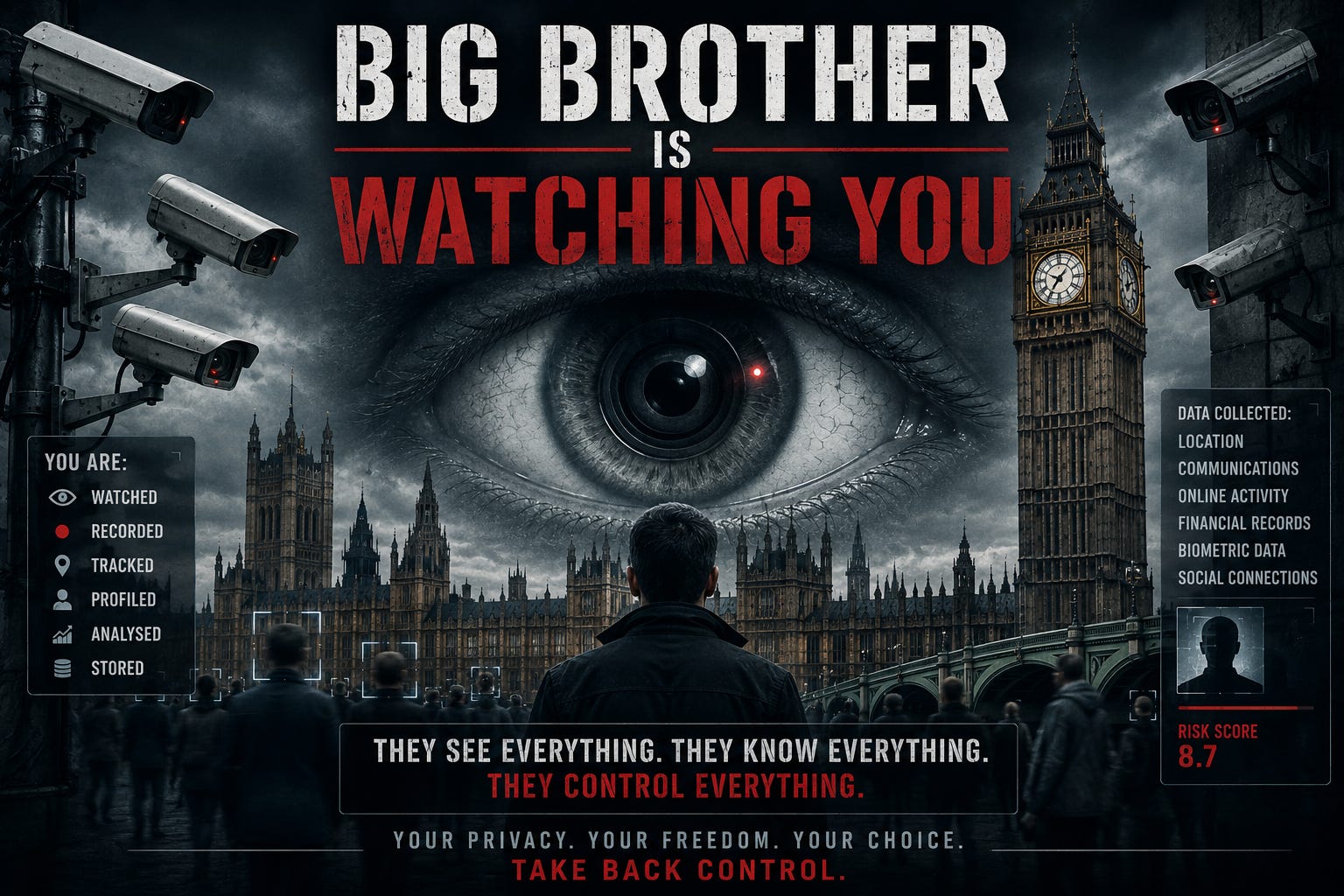
The Database State
Behind the cameras and the scanners sits a database infrastructure that most British citizens do not know exists.
The Police National Database holds approximately 19 million facial images. That is roughly one photograph for every three adults in the United Kingdom, held by the police. Hundreds of thousands of those images belong to people who were never charged with an offence, let alone convicted. People who were arrested, questioned and released. People whom the criminal justice system examined and found no cause to prosecute. Their photographs remain on a police database, searchable by facial recognition algorithms, more than a decade after a court ordered their deletion.
That is not a misprint. In 2012, the High Court ruled that the retention of custody images of unconvicted people was unlawful. The ruling was unambiguous. The police were retaining biometric data of innocent citizens in the same manner as convicted offenders, and the court said this was not lawful. More than twelve years later — in late 2024 — the biometrics commissioner confirmed that police forces were still holding millions of those images. The explanation offered by the Home Office was that the database lacked the technical capability to delete records in bulk. A court said delete them. The government said the computer won’t let us.
And whilst those images sit there, undestroyed, they are not gathering dust. Approximately 25,000 facial recognition searches are conducted against this database every month. Photographs of innocent people — people a court said should have their images deleted — are being actively searched by algorithms looking for matches.
The National DNA Database holds over six million DNA profiles. The national fingerprint database holds millions more. ANPR records log billions of vehicle movements annually. Internet connection records are retained for twelve months by every service provider in the country. Communications metadata is stored as a matter of legal obligation.
And the government wants more.
In August 2025, the Home Office announced a predictive policing project — the ‘Concentrations of Crime Data Challenge’ — that will integrate facial recognition with AI-powered interactive crime maps. The system will synthesise data from police, councils and social services — including criminal records, previous incident locations and behavioural patterns — to direct law enforcement resources. The stated goal is preventing crime before it happens. A prototype was scheduled for April 2026.
The implications deserve careful consideration. A system that draws together criminal records, social services data and behavioural patterns to predict where crime will occur. The question that predictive policing inevitably raises — and that its advocates consistently decline to answer satisfactorily — is this: what happens to the communities that the algorithm identifies as high-risk? Do they receive investment, or do they receive more surveillance?
Then, in September 2025, the government announced its digital identity scheme — ‘BritCard’ — which would require biometric verification including facial photographs linked to personal data such as name, date of birth, nationality and residency status. The initial announcement included a commitment to making digital ID mandatory for right-to-work checks.
The public response was immediate and overwhelming. A parliamentary petition opposing the scheme gathered nearly three million signatures — one of the most-signed e-petitions in British history. Public support for the scheme collapsed from 57 per cent to 32 per cent once the mandatory element was announced. The government performed a partial U-turn in January 2026, making the scheme voluntary.
But the infrastructure is being built regardless. The consultation is underway. The architecture is being designed. And every reader of this investigation now knows enough about the pattern to ask the obvious question: if a power is created, how long before it is exercised?
The China Comparison
It is at this point that the comparison becomes unavoidable. And deeply uncomfortable.
China has an estimated 200 to 700 million surveillance cameras — roughly one camera for every two to seven citizens. Eight of the ten most surveilled cities in the world are in China. The country operates the ‘Skynet’ and ‘Sharp Eyes’ surveillance networks, integrating facial recognition and behavioural analytics across urban and rural areas.
China’s Social Credit System links surveillance data to consequences. Travel restricted. Financial services denied. Education and employment blocked. Behaviour scored by the state. Facial recognition feeds linked to social credit databases, with flagged individuals identified automatically at transport hubs.
Let us be clear about what separates Britain from China, because fairness demands it.
Britain does not have a social credit system. Britain has independent courts. It has parliamentary scrutiny. It has a free press. It has judicial review. It has a democratic mandate that China’s government entirely lacks. These are not trivial distinctions. They are fundamental. They are the reason Britain is not China, and this investigation does not argue otherwise.
But consider — carefully, and on the evidence — what Britain does have.
Britain has one of the highest CCTV densities on earth. In its capital, that density is comparable to — and in some boroughs exceeds — Chinese cities.
Britain has a national ANPR network that logs 60 million vehicle movements daily and stores the data for a year. Big Brother Watch has described it as ‘one of the biggest surveillance networks on the planet.’ AI is now being applied to that network to identify ‘suspicious’ journeys — not journeys by suspects, but journeys the algorithm considers unusual.
Britain has a government that issued a secret order demanding encryption backdoors from the world’s largest technology company, stripped encryption protections from its own citizens when that company refused, and placed dormant powers on the statute book to scan every encrypted message in the country.
Britain has a police database of 19 million facial images — including hundreds of thousands of people never charged with any offence — searchable by facial recognition algorithms, retained for over a decade in documented defiance of a High Court ruling.
Britain has live facial recognition deployed at political protests, expanded to permanent camera installations across city centres, and rolled out through handheld devices carried by individual officers — all without dedicated primary legislation.
Britain has a government investing £115 million in AI-assisted policing, building predictive crime maps that synthesise police, council and social services data, and constructing a national biometric identity infrastructure.
None of these facts is disputed. All of them are documented. The question they collectively pose is not whether Britain is China. It is whether the gap between British surveillance capabilities and Chinese surveillance capabilities is as wide as the British public has been led to believe — and whether that gap is growing or shrinking.
The evidence, on every front examined in this investigation, points in one direction.
The Ratchet
There is a word for the pattern that emerges when you lay these developments end to end. It is ‘ratchet.’ The mechanism turns in one direction only.
The Regulation of Investigatory Powers Act 2000 gave way to the Investigatory Powers Act 2016. The 2016 Act gave way to the Investigatory Powers (Amendment) Act 2024. Each iteration expanded the state’s surveillance powers. None reduced them. Not one provision in any of these Acts pulled back a capability that a previous Act had granted. The ratchet turns. It never turns back.
ANPR was introduced as a counter-terrorism measure. It is now used for traffic enforcement, emissions monitoring and AI-assisted pattern analysis of journeys made by the general public. Facial recognition began as limited police trials. It is now permanent street-level infrastructure, deployed at protests, and about to be standardised across every police force in England and Wales. Custody images were taken for identification purposes. They now sit in a database of 19 million photographs, searchable by algorithms, retained in open defiance of a court order.
Every single expansion has been justified by the same three arguments: national security, child protection, public safety. These are not illegitimate concerns. They are deeply serious. No reasonable person dismisses them.
But the documented record shows — without exception — that these arguments have been deployed to justify every extension of state surveillance power. And they have never, on any occasion, been deployed to argue for its restraint. Not once. Not by any government. Not under any party. The justification is always the same. The direction of travel is always the same. The ratchet turns.
The question this investigation poses is not whether Britain is China. It is not. The question is whether a democratic nation can assemble the technical infrastructure of an authoritarian surveillance state — piece by piece, Act by Act, camera by camera — and rely on political goodwill alone to prevent its misuse. Whether the tools themselves, once built, respect the intentions of the people who built them. Whether a future government — less scrupulous, less restrained, less committed to democratic norms — would find anything in the current framework capable of stopping them from using these powers to their fullest extent.
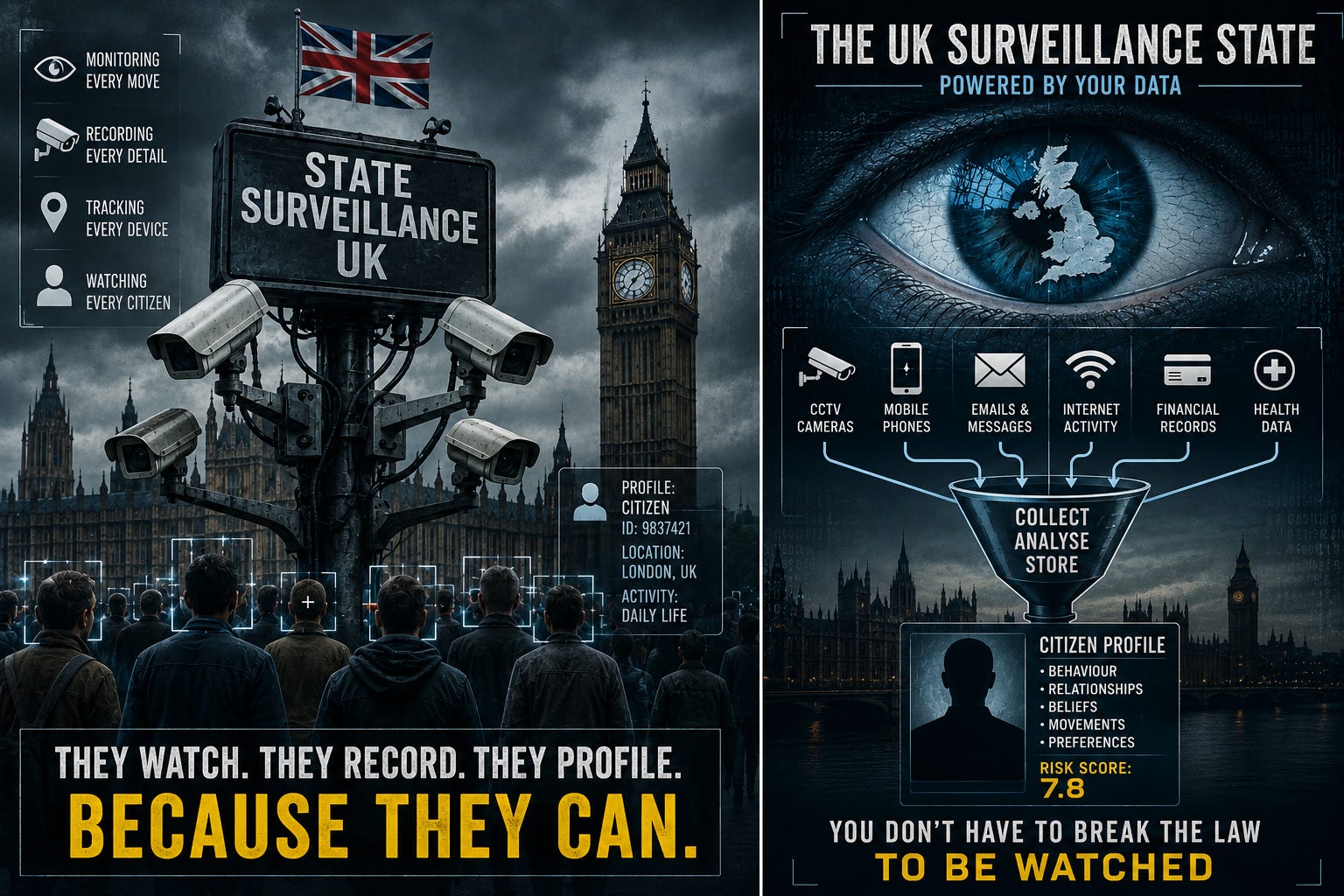
The Verdict
Previous generations of Britons refused national identity cards. They regarded the surveillance of political activity as an abuse of power. They treated the privacy of personal correspondence as a fundamental right — not a privilege to be withdrawn at ministerial discretion. They would have found the idea of a government database containing 19 million photographs of its own citizens — including those never convicted of any crime — not merely alarming but intolerable.
Every piece of evidence presented in this investigation is drawn from government legislation, official reports, parliamentary documents, court rulings, police disclosures and the government’s own published statistics. None of it is speculation. None of it is hyperbole. All of it is on the public record, available to any citizen who cares to look.
The surveillance infrastructure described in these pages was not built in secret by a rogue state. It was built in the open, piece by piece, statute by statute, camera by camera, by successive elected governments of the United Kingdom. It was built with the stated intention of keeping the public safe.
Whether it has done so is a question the public is entitled to ask. Whether the public was ever meaningfully consulted about the surveillance state being constructed around them is a question that answers itself.
Britain has not become China. But it has built the tools. And it has built them with a speed, a scale and a legislative enthusiasm that should give every citizen of this country pause.
What happens next depends entirely on whether anyone in power can be trusted — not just today, but permanently, irrevocably, without exception — never to use them.
History does not encourage optimism.
Independent political analysis takes time and resources. To keep these articles free and accessible to everyone rather than locked behind a paywall, I rely entirely on voluntary reader support. If you value this work, please consider dropping a quick one-off tip in the coffee jar.