

They Built a Monster: How Labour's Propaganda Game Spawned Its Own Nemesis

The Home Office paid to create Amelia — a cartoon villain meant to make your children afraid of their own opinions. Instead, they handed the dissident right its most potent mascot in years. A masterclass in establishment incompetence.
Somewhere in a government office — probably one with a “Safe Space” sticker on the door — a civil servant is having a very bad spring. They spent taxpayer money commissioning an online game to convince British teenagers that caring about their country is a mental illness. And now that game’s villain has been printed on protest placards, rendered in AI epic paintings, and chanted about in Parliament Square by women in purple wigs. Well done, everyone. Truly extraordinary work.
This is the story of Amelia — the accidental mascot of a movement the British establishment cannot name, cannot understand, and increasingly cannot control.
What Your Taxes Actually Bought
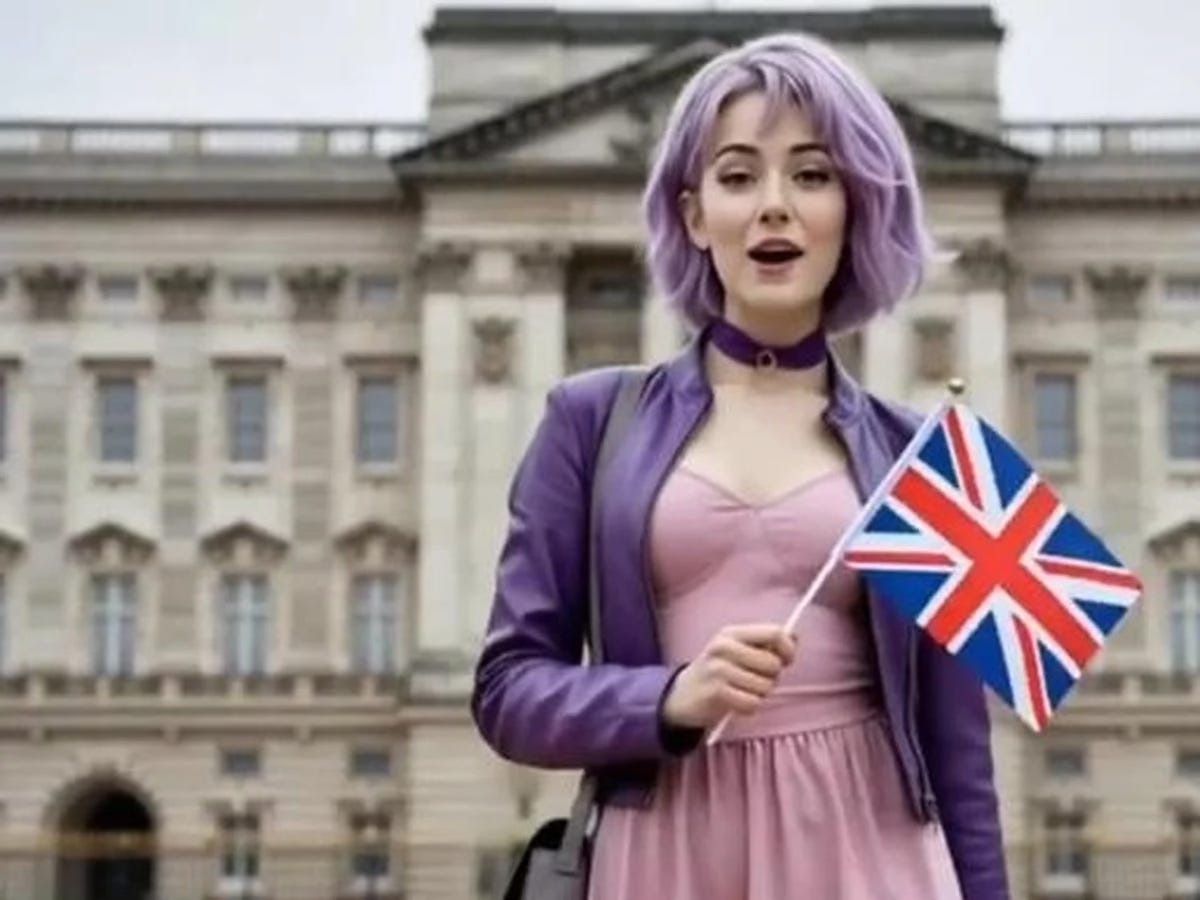
Let us be precise about what the Home Office chose to fund. Pathways: Navigating Gaming, the Internet & Extremism is a game deployed in secondary schools across Yorkshire. Its premise: a student called Charlie must resist the corrupting influence of classmate Amelia — a purple-haired goth girl who believes in border controls and worries about the effects of mass immigration. In the game’s world, these views are the first steps on a road to fascism.
The fatal design flaw: Multiple playthroughs revealed that no matter which choices the player made — however cautious, however “correct” — the ending was always the same: a referral to the Prevent deradicalisation programme. The message to every British teenager who played it was unambiguous: you are already suspect.
A government-funded product, targeted at white British schoolchildren, in which the only playable character is white, and in which virtually every path ends with the child flagged as a potential extremist. If a foreign power had designed a tool to make young Britons feel surveilled and alienated from their own institutions, they could not have done better. Our own government got there first, and billed us for the privilege.
The Internet Does Not Obey
When the game surfaced on X in early January 2026, there was no solemn nodding. No workshops convened. Instead, within hours, the dissident internet looked at the character designed to embody everything they were supposed to fear — and said: she’s right, actually. And she’s kind of brilliant.
The memes came in waves. Amelia as a medieval warrior. Amelia as the Arthurian Lady of the Lake, raising Excalibur from the Thames. Amelia meeting Paddington Bear, sharing a pint, reading Harry Potter. AI tools — many of them American, and therefore beyond the reach of Starmer’s speech laws — produced thousands of images a day. Posts exploded from 500 a day to over 11,000 within weeks.
What Prevent’s architects fail to understand is a basic truth about human nature: when an institution treats ordinary patriotism as pathology, it does not cure the patient. It breeds contempt. And contempt, online, is rocket fuel.
Starmer’s Britain, in One Purple-Haired Character
Amelia resonated not because she is a sophisticated symbol, but because she is an accidentally honest one. The designers thought they were creating a villain. They created a mirror — a reflection of how millions of Britons feel they are perceived by their own government.
Under Starmer’s Labour, the message to the working and middle class has been consistent, if never quite stated aloud: your cultural attachments are embarrassing, your concerns about immigration are bigotry, your desire to see your community maintained is a dog-whistle. Amelia — a schoolgirl who wants to go on a march, believes English people have rights worth defending, and ends up in a Prevent referral for it — is not an exaggeration of that message. She is a distillation of it.
From Screen to Street
The moment the phenomenon crossed from internet irony into something more durable came on the 7th of February. Members of the Women’s Safety Initiative gathered in Parliament Square — in front of the statue of Millicent Fawcett, the great suffragist — wearing purple wigs. Nine women. A small crowd. But with a clarity of message that most professional campaigns spend millions trying to manufacture: We Are All Amelia.
Their chant was borrowed from a government-funded cartoon character. Their ground was chosen deliberately — the Square that has hosted every significant democratic protest in modern British history, in the eyeline of the Parliament that funds the very programme that made their mascot famous.
You can call them far-right. You can question their statistics. You can note — correctly — that some online content bearing Amelia’s image is genuinely hateful. But you cannot dismiss the dynamic that put them there. Women feel unsafe. They feel unheard. And when they raise concerns, they are treated exactly the way Pathways treats Charlie: as a problem to be managed, not a citizen to be heard.
Within weeks the character had spread across Europe. Germany got “Maria” in a Bavarian dirndl. The Netherlands got “Emma.” Ireland got its own Amelia. The think tanks called it an international far-right network. Perhaps. Or perhaps it means the conditions that produced the British Amelia exist in every country where a professional class has decided that national sentiment is a mental illness requiring treatment. The kindling was already everywhere. The game merely lit the match.
The Verdict
The establishment’s response was predictable: delete the game, condemn the memes, wait for it all to go away. It won’t. You cannot delete a feeling.
The Home Office spent public money producing a resource so clumsily propagandistic, so contemptuous of the children it claimed to help, that the internet took its villain and made her a hero. Real women marched under her banner in the shadow of Parliament. Her face spread across a continent. Elon Musk retweeted her. She briefly had a cryptocurrency.
It is an own goal in the most literal sense. But it is also a monument to the profound, almost wilful inability of the British establishment to understand the country it governs. They looked at millions of people with legitimate concerns and saw only a problem to be corrected. Amelia looked back — purple hair, pink dress, Union Jack in hand — and said: no, actually. You’re the problem.
And a remarkable number of people agreed.
A note on the darker content: Some Amelia memes are genuinely racist and deserve no defence. But the existence of hateful fringe content does not answer why the phenomenon exists at all. Conflating the two — treating the legitimate grievance as identical to the hateful fringe — is precisely the error that produced Pathways in the first place.
Your support helps turn our voices into power. It’s how we start being feared instead of managed.
Prefer a one-off contribution?
Now THIS article made my day!! Thank you for recounting the Amelia story, it a winner and we so need wins! I hope it never stops!
I have my Amelia t-shirt, saved for those occasions when I'm likely to bump into one of the tiny minority of Prevent-lovers.