

They Called Her a Fascist Beast. Now She’s Dead.

How years of reckless rhetoric from Britain’s political class built the climate in which Ann Widdecombe was murdered
Ann Widdecombe is dead.
Found in her Devon home on 9 July 2026 with serious injuries. A 78-year-old woman. Alone. Counter-terrorism police have confirmed it was a targeted attack. A 28-year-old man drove over 300 miles from Rotherham to her isolated cottage on the edge of Dartmoor to kill her.
We do not yet know the motive. The investigation is live. The suspect has been rearrested under the Terrorism Act.
But we know the climate.
We know it because it has been built, brick by brick, word by word, by some of the most powerful people in British politics. And it is time someone laid it all out.
The Charge Sheet
This is a record. Not of opinions. Not of interpretation. A record of what was said, by whom, and when. These are the words of serving government ministers, deputy prime ministers, party leaders, and peers of the realm. Words directed at Nigel Farage, at Reform UK, and at Ann Widdecombe herself.
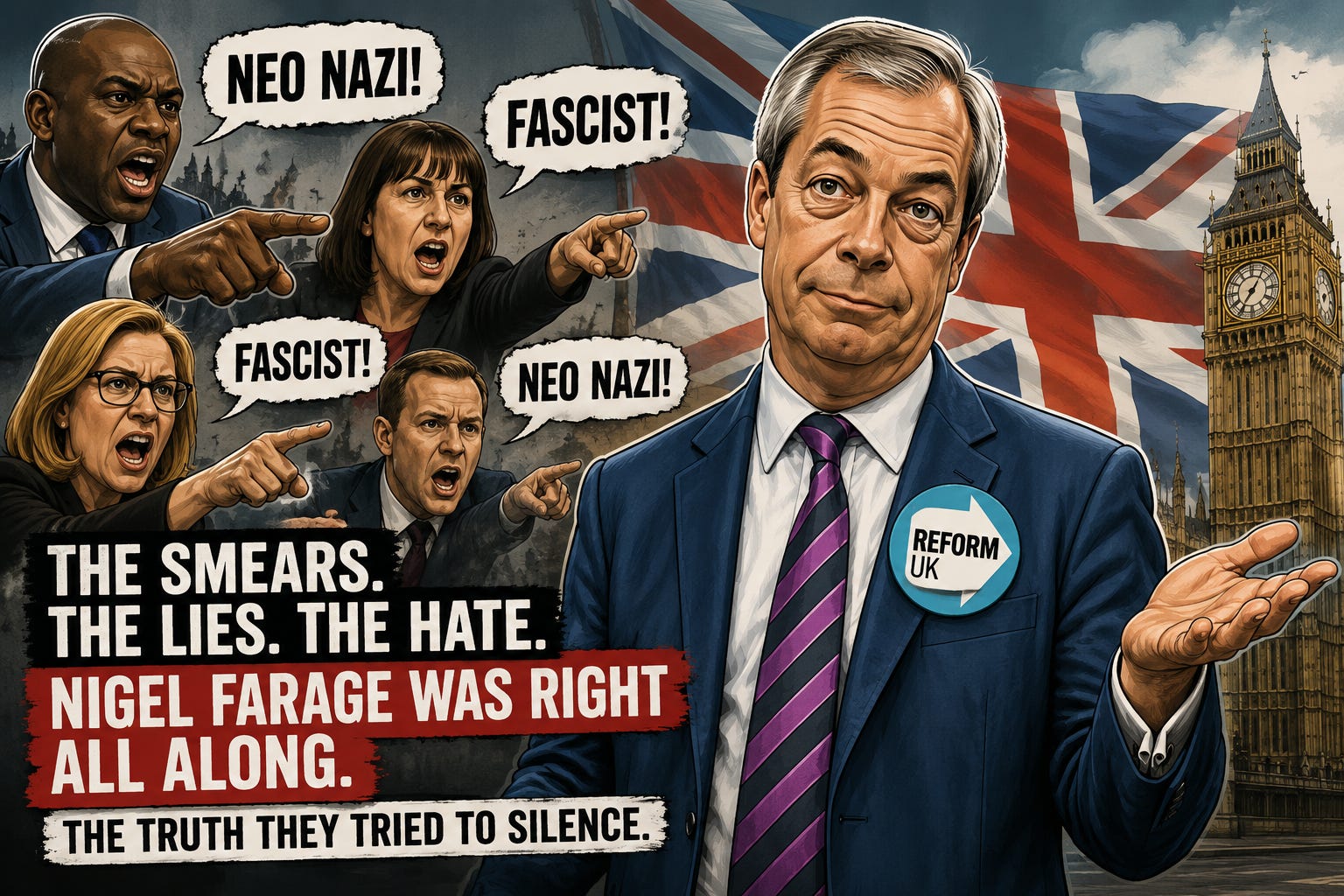
Jess Phillips, then a Labour MP and later Minister for Safeguarding and Violence Against Women and Girls, tweeted in 2010: that Ann Widdecombe “better go this week” because she was “a little fascist beast.” She was talking about Strictly Come Dancing. She was calling a sitting parliamentarian a fascist beast.
David Lammy, now Deputy Prime Minister, called Widdecombe “poisonous” in 2019 after she made comments about science and sexuality. He called her a bigot who wanted to “drag us back to the 19th century, throwing minorities out in the cold along the way.” Then he added five words that deserve to sit in the public record forever: “We must stand up to them before it’s too late.”
Before it’s too late.
Wes Streeting, now Health Secretary, tweeted: “If only science had a cure for Ann Widdecombe.” Snide. Dehumanising. Treating a human being as a disease.
These were not random accounts on social media. These were people who now hold the levers of state power. And Ann Widdecombe was not their only target.
The Escalation
Lammy has form. He did not start with Ann Widdecombe and he did not stop with her.
In 2019, he compared pro-Brexit Conservative MPs in the European Research Group to Nazis. Not as a slip. Not in the heat of the moment. He was asked by the BBC’s Andrew Marr whether the comparison was appropriate. His reply: “I would say that wasn’t strong enough.” He went on to invoke Churchill’s stand against Hitler. He was talking about elected colleagues in the House of Commons.
He has called Donald Trump “a woman-hating, neo-Nazi-sympathising sociopath.” He called him “a racist KKK and Nazi sympathiser.” When he was made Foreign Secretary, these comments were treated as an embarrassment to be managed. Not as a disqualification. As an inconvenience.
Then came September 2025 and the Labour Party conference. The party was in freefall. Reform UK was leading in the polls. A strategy was needed. The strategy they chose was escalation.
Keir Starmer stood at the podium and called Reform’s policies “racist” and “immoral.” He told the conference hall this was “a fight for the soul of our country.” He told Farage: “We will fight you with everything we have.” He said Farage “doesn’t like Britain” and “doesn’t believe in Britain.” He framed the leader of the most popular party in the country as an existential enemy of the state.
Days later, on the BBC’s Politics Live, Lammy was asked whether Farage was a racist. His answer was to tell the public to “come to their own judgements about someone who once flirted with Hitler Youth when he was younger.” He was referring to allegations from Farage’s schooldays in the early 1980s that Farage has always denied. Lammy was forced into a half-retraction within hours. His so-called clarification: “He has denied it and so I accept that he has denied it.” Not an apology. Not a withdrawal. An acceptance of a denial. The accusation was made. The damage was done. The clip had already travelled.
The Full Bench
It was not just Labour.
Lord Heseltine, at the Conservative Party conference in October 2025, compared Reform UK to “the fascists of the 1930s.” He called them “a reincarnation of Oswald Mosley and his fascists in the Thirties when it was the Jews.” He later told The Times that his “final contribution” in politics would be to “stop Nigel Farage for the welfare of this country.” He called Farage “a reincarnation of that human instinct to distrust something different from yourself.” He said he wanted to “expose Reform for what they are.”
Ed Davey, leader of the Liberal Democrats, stood at his party conference in September 2025 and declared that “the greatest threat to the Britain we love doesn’t come from Tehran or Moscow. It comes from within. I’m talking about Nigel Farage and Reform.” He called Farage a representative of “the forces of darkness.” He referenced Farage at least thirty times in a single conference speech. He accused Reform of wanting to turn Britain into “Trump’s America,” complete with mass shootings and children doing active shooter drills.
Pause on Davey’s words for a moment. Vladimir Putin has murdered people with poison on British soil. The Iranian regime has planned and attempted terrorist attacks on British soil. And the leader of a mainstream political party stood in front of cameras and told the country that the real threat — the greatest threat — was Nigel Farage.
Lucy Powell, Labour’s deputy leader, called Reform “a cancer and a poison” in January 2026 during the Gorton and Denton by-election campaign. When a cabinet colleague was asked on live radio whether Reform really was a cancer, the minister pointedly distanced herself from the word. Powell was not disciplined. She was not asked to retract. She went on, after Widdecombe’s murder, to stand in the House of Commons and claim she had “greatly admired and respected” the woman whose party she had called a cancer six months earlier.
The Pattern
Read the charge sheet again. Read it slowly.
Fascist. Nazi. Cancer. Poison. Disease. Threat from within. Forces of darkness. Worse than Moscow. Worse than Tehran. A thing to be stopped before it’s too late.
This is not the language of political disagreement. This is the language of existential threat. It is the language that says: these people are not opponents. They are enemies. They are a danger. They must be eliminated.
Not one of the politicians who used these words meant them as a literal instruction to commit violence. That is obvious. But the concept of stochastic terrorism does not require intent. It requires only a sustained campaign of dehumanisation, broadcast to millions, that frames a group or an individual as so dangerous, so monstrous, so uniquely threatening that some unstable person, somewhere, decides to act.
Reform’s Zia Yusuf, in his press conference on 15 July 2026, put it with devastating clarity: “If we are this huge, supposed threat, if we are truly ‘Neo Fascist’ as one prominent politician described us... then how can we be remotely surprised when there are some people in this country who might take it upon themselves to extinguish that threat with lethal force?”
The Violence Was Already Happening
None of this appeared from nowhere.
Nigel Farage has been physically assaulted in public multiple times. In 2019, a man threw a milkshake over him while campaigning in Newcastle. He was convicted of common assault. In 2024, a woman threw a McDonald’s milkshake at Farage outside a pub in Clacton on the day he launched his general election campaign. She was convicted and given a suspended prison sentence.
These incidents were laughed at. Celebrated on social media. Treated as comedy. The normalisation of political violence against a specific target, dressed up as protest.
Since February 2026 alone, Farage has received more than 600 death threats. Six hundred. In five months. On 16 July, three days ago, a man was arrested for threatening to shoot him.
Ann Widdecombe had no security. None. A 78-year-old woman living alone in rural Devon who served as Reform UK’s immigration and justice spokesperson. A woman who had spent over forty years in public life — as a Member of Parliament, a Member of the European Parliament, a government minister. She had no protection.
Neither did Jo Cox when she was murdered in 2016. Neither did David Amess when he was murdered in 2021. Britain is the only major democracy in the world where elected representatives routinely go about their work without any security whatsoever. Three politicians murdered in a decade. And the government’s response has been to do nothing about it.
The Brass Neck
What happened after Widdecombe’s death tells you everything about the people who built this climate.
Adam Boulton appeared on Sky News and referred to Ann as a “spinster” and an “old maid.” This was after he knew she was dead.
Peter Tatchell called her a “bigot.” After she was dead.
Labour MPs queued up to offer their condolences. The same Labour MPs whose colleagues had called her a fascist beast. Whose leader had called her party a cancer. Whose Deputy Prime Minister had told the country to stand up to “them” before it was too late.
Lucy Powell, who called Reform a cancer and a poison, stood in the House of Commons and spoke of her “admiration” for Widdecombe. Then she pivoted, seamlessly, to calling for more online speech restrictions. A woman had been murdered in her own home by a man who drove 300 miles to find her, and the political establishment’s instinct was not to ask whether its own rhetoric bore examination. It was to demand that everyone else be silenced.
The Question That Must Be Asked
This article does not claim that any politician caused Ann Widdecombe’s death. The investigation is ongoing. The motive has not been confirmed.
But a question must be asked, and it must be asked directly.
When you spend years calling people fascists, Nazis, a cancer, a poison, the greatest threat to Britain, something that must be stopped before it’s too late — what do you think happens?
When you tell a country of sixty-seven million people that a political party and its representatives are a danger comparable to or greater than hostile foreign states that have committed murder and planned terrorism on British soil — what do you think some of those people will conclude?
When you dehumanise a 78-year-old woman as a “fascist beast” and a “disease” and a “bigot” who must be stood up to before it’s too late — what climate are you creating?
Words are not just words. Every politician in Britain knows this. They know it because they passed the Online Safety Act. They know it because they police social media posts by ordinary citizens for “hateful” speech. They know it because they will prosecute a man for a tweet but shrug when a Deputy Prime Minister links a political opponent to the Hitler Youth on national television.
The rules, as ever, apply only in one direction.
Nigel Farage lives under permanent threat. Six hundred death threats in five months. Multiple physical assaults. A man arrested this week for threatening to shoot him. His colleague murdered in her home.
And the people who spent years building the rhetorical framework that made all of this thinkable are now standing in Parliament expressing their shock.
They are not shocked. They should not be allowed to pretend that they are.
Britain’s political class did not pull the trigger, swing the weapon, or drive the 300 miles to Devon. But they built the road. They painted the signs. And they pointed the way.
It is time for that to be said out loud. Because Ann Widdecombe can no longer say it herself.
Independent political analysis takes time and resources. To keep these articles free and accessible to everyone rather than locked behind a paywall, I rely entirely on voluntary reader support. If you value this work, please consider dropping a quick one-off tip in the coffee jar.
Very high praise for this article!!! The galloping hypocracy from these named leaders is disgusting! I am very glad that you are calling them out for their depraved comments and lets hope more people become acutely aware of just who is in charge.
One really wonders where old-fashioned, respectable democracy has gone to.
Such disgusting words, such as those thrown at the late Ann Widdecombe, are neither respectable nor democratic, they are mouthed by disgusting, disrespecting and disgraceful people in positions of authority and TRUST, who should know better!
Just shows what sort of people our schools and universities are turning out nowadays!!