
UK Politics’ Midlife Crisis: Why the Tories Abandoned You
If you voted Reform UK in 2024—or you’re seriously considering it in 2026—you’ve probably noticed something peculiar about Westminster lately. Both Labour and the Conservatives are chasing voters who barely exist, whilst ignoring the millions sitting right in front of them.
They’re experiencing a political midlife crisis, and frankly, you’re paying the price.
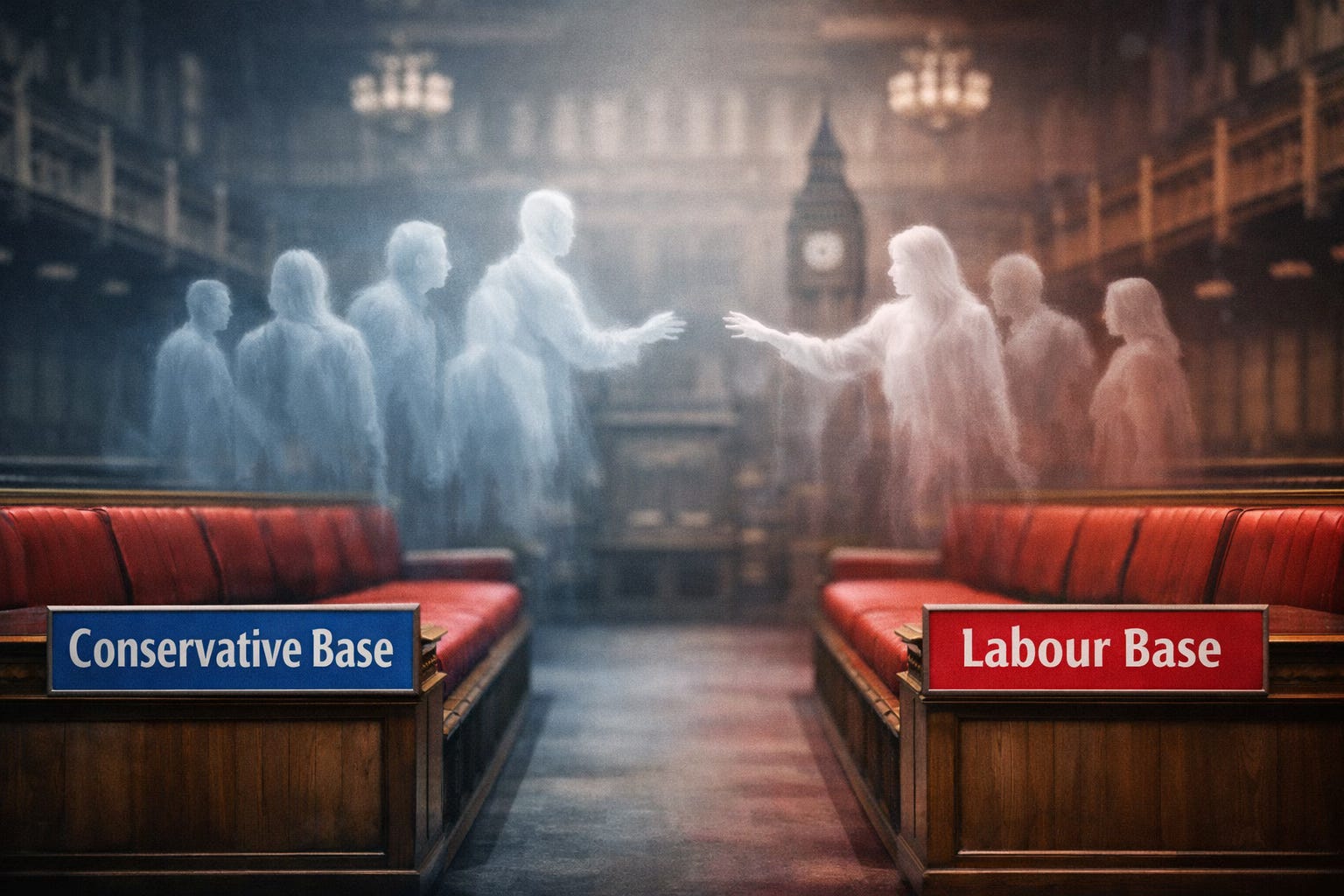
The Disconnect Nobody’s Talking About
Here’s the thing: voter data paints a stunning picture of disconnect between what the major parties are doing and what their actual supporters want.
Labour’s base—their real base—skews left on economics and social tolerance. They align with the Lib Dems and Greens on things like state ownership, accepting protests, and cultural liberalism. Yet what’s Starmer doing? Lurching right on economics and culture to chase “Don’t Know” voters who lean Reform. He’s abandoning his coalition to court voters who will never vote for him.
The Conservatives? It’s worse. They’ve spent eighteen months watching a third of their vote leak to Reform. What’s their response? Not to reckon with why—immigration concerns, economic stagnation, cultural anxiety—but to obsess over the same phantom moderate voters they’ve been chasing since 2010. Meanwhile, Reform supporters have been consistently clear: you want borders taken seriously, you want growth that benefits ordinary people, and you’re tired of being lectured about your values.
Instead, you get Peter Kyle—Labour’s Business Secretary—making bizarre remarks about universities, or Tory grandees wringing their hands about “extremism.” The subtext is always the same: your concerns are fringe. Illegitimate. Un-British.
They’re wrong.
What the Data Actually Shows
Recent polling is damning for Westminster’s establishment consensus. Reform supporters are not some fringe protest vote—they represent a genuine realignment of British politics around themes the two major parties pretend don’t exist.
Reform voters and Conservative voters differ dramatically on economics and social issues. You’re not shy about wanting controlled immigration, scepticism of mass globalisation, or concerns about woke capture in institutions. Labour’s base wants state intervention on the economy; yours wants growth and stability. You’re sceptical of endless “progressive” cultural shifts; they’re not.
Yet both parties act as though these voters—your voters—are anomalies to be managed rather than constituencies to be served.
Labour especially has invented a mythology around the “Red Wall” collapse, blaming Russian bots and populist delusion instead of asking: Why did working-class voters stop trusting us? The answer, inconveniently for them, isn’t mystical. It’s about immigration policy, it’s about feeling left behind economically, it’s about cultural condescension. But admitting that requires changing course. So they don’t.
The Tories, meanwhile, won in 2019 on a promise to “Get Brexit Done” and take immigration seriously. Then they didn’t. Migration hit record levels. Net migration soared. The “small boats” problem went unsolved for years, despite being the defining issue for millions of voters. So you moved. To Reform. Rationally.
And the response? Not “We hear you and we’re fixing it.” But “You’re voting for a protest party.”
The Real Crisis
Here’s what keeps Westminster awake at night—though they’d never admit it: the two-party system is cracking.
Only 12% of Britons trust political parties. Youth wellbeing has stagnated or declined. 44% of people report facing discrimination. Growth is anaemic. The public sector is overstretched. Crime concerns persist. And instead of parties offering coherent solutions, you get triangulation and signal-posting to phantom voters.
When you ignore a third of your voter base whilst chasing people who won’t vote for you anyway, something’s got to give. For the Conservatives, it already has. For Labour, it’s coming.
The fragmentation you’re seeing—Reform on the right, Greens and Lib Dems on the left—isn’t going away. It’s structural. It reflects genuine ideological differences that the old two-party framework can’t contain. Multi-party fragmentation forces realignment, and Westminster knows it. They’re just terrified of what that realignment looks like.
The Uncomfortable Truth
There’s a doomerism doing the rounds in British politics right now. Listen to some commentators and you’d think we’re on the brink of societal collapse: immigration will “break” Britain, woke ideology is destroying everything, crime is apocalyptic, we’re finished.
Some of this is real concern. Much of it is rhetorical amplification. Britain faces challenges—low growth, an overstretched public sector, genuine social tension—but we’ve faced worse. The 1970s saw actual blackouts and industrial chaos. The post-war period rebuilt from rubble. Yet now, any problem is treated as existential crisis by a political class that’s lost the ability to deliver on anything.
That erodes trust further. It makes voters turn to outsider parties. And it prevents the serious conversation we actually need: How do we grow the economy? How do we manage immigration sustainably? How do we reduce state dependency without destroying the safety net?
These aren’t fringe questions. They’re the questions Reform supporters—and plenty of Conservatives—actually want answered.
What Comes Next?
Here’s the prediction nobody wants to make: the 2026 local elections and any by-elections between now and the next general election will be a bloodbath for Labour.
Starmer’s coalition—young progressives, university-educated metropolitan voters, and just enough working-class nostalgia—is fragile. Once the “not-the-Tories” magic wears off (and it’s already wearing), what’s the pitch? Another ten years of managed decline?
The Conservatives are in no better shape. Their problem is acute: they’ve lost your vote because they didn’t deliver on their promises. Merely “being less bad than Labour” won’t win it back. They need to actually reckon with Reform as a political force, not a protest.
That means taking immigration seriously—not with gesture politics, but with genuine policy resets. It means acknowledging that growth matters more than woke posturing in institutions. It means remembering that working-class voters aren’t a problem to be solved—they’re the core constituency that kept the party in power for most of the last century.
Will they do it? The evidence suggests no. Which means Reform’s challenge becomes: can you move from protest vote to actual party of government?
The Question for You
British politics is at a crossroads. For the first time in decades, the two-party system is genuinely fragmenting. The Conservatives have abandoned you. Labour never wanted you. Reform is growing.
The question isn’t whether you’re right to feel let down. You clearly are. The question is what happens next—and whether the political system can adapt before it breaks entirely.
One thing’s certain: the days of both parties taking you for granted are over.
What do you think? Is Reform the answer, or is the real solution forcing the Conservatives to remember who they’re supposed to serve? Drop your thoughts in the comments—and if you want more on where British politics is actually heading, subscribe below.
Tories have not really had a good leader since Thatcher and one of my main dislike of Tories is the fact they are quick to turn on the leaders that the voters elected which aways turns into a disaster. Labour has always been a disaster when in government and ended up running the country into the ground which then takes years to sort out.
Tories had every opportunity to tackle issues facing country when in power and didn't.
Labour lied to get in and are doing what they always do on a bigger scale and in a short time destroying the country.
Both have relied on 2 main party system which has now come to end. Labour should never be in power again.
Tories have a lot of work to do, listening to what the public want which I dont see much sign of. Both need to stop bashing Reform with labels, far right etc as in doing so it is attacking the many Reform supporters. Not a bright idea. 2 party system needs breaking and Reform can do that, its time for a different direction which Reform is offering and honest enough to say its not going to be easy .