

Manufactured Consent: The Architecture Behind Britain's Rape Gang Cover-Up
Part One

Part one of a two part response to the “Rape Gang Report”
How Institutions Chose Silence
The Lowe Inquiry has now documented what Britain’s institutions have known for decades and chosen to deny: 250,000 girls—minimum—systematically raped, trafficked, tortured, and discarded while the state actively protected the perpetrators. Not through neglect. Through policy
The scandal wasn’t hidden. It was Built.
What the report reveals—in meticulous, devastating detail—is not institutional incompetence but institutional choice. Every agency knew. Police forces, social services, schools, the NHS, local councils, MPs, government departments. They possessed the intelligence, the evidence, the legal authority to act. They chose silence. They chose denial. They chose to protect the reputation of their institutions over the lives of children.
And the mechanism that made this systematic, that transformed individual cowardice into institutional policy, was fear. Specifically: terror of being accused of racism.
This is not speculation. The report documents it case by case, institution by institution. A police call handler tells a mother: “You can’t describe them as Asian men because that’s racist. You should just be glad your child is being taught a different culture.” A police officer returns a child to the house where she is being raped and tells the abusers to “have fun with her.” Care home staff are explicitly warned they’ll lose their jobs if they record the registration plates of vehicles collecting children for exploitation. Social services close cases despite clear indicators of trafficking. The NHS discharges sexually injured children back to their abusers without safeguarding referrals.
These were not isolated failures. They were expressions of a unified institutional logic: the fear that confronting the crime would invite accusations of racism, and that fear was weaponised into policy.
The Legal Foundation: How Britain Built the Machinery of Silence
To understand why institutions paralysed themselves, you must understand the legal and cultural architecture that made them do so.
It did not happen by accident.
The foundation was laid in 1965 with the Race Relations Act. Its intention was to combat overt discrimination. Its effect, over decades, was to create an environment in which discussing ethnicity in crime patterns became professionally and legally hazardous. The framework was strengthened in 1976, then turbocharged in 1999 by the Macpherson Report.
Macpherson branded the police “institutionally racist” and introduced a definition of racism so broad, so elastic, that police officers and social workers across the country became terrified of any action that could be construed as targeting ethnic minorities. The chilling effect was immediate and deliberate.
But the real transformation came under Tony Blair’s New Labour, which understood that if you wanted to neutralise discussion of ethnicity in crime, you needed to embed it in law. The Equality Act 2010 consolidated and strengthened anti-discrimination protections by adding religion as a protected characteristic alongside race. Combined with hate crime legislation under Part III of the Public Order Act 1986 and the Crime and Disorder Act 1998, it created an environment where criticising patterns of offending linked to Muslim communities could be legally framed as racial hatred or Islamophobia.
The result was deliberate: a legal framework that made naming uncomfortable truths professionally, legally, and politically dangerous.
Police forces, social services, and local councils didn’t fail to act because they were incompetent. They failed to act because the political and professional costs of appearing to scrutinise Muslim communities was deemed, by institutional leadership, to be too high. The risk to institutional reputation outweighed the duty to protect children.
This is corruption. Full stop. Not the crude embezzlement kind. The institutional kind, where the preservation of organisational standing becomes more important than institutional mission.
The Mechanism: How Fear Became Active Enablement
The paralysis was real. But it was worse than paralysis. Institutions didn’t merely fail to act. They acted to protect perpetrators.
Consider the case of Fiona.
Fiona entered a children’s home in 2008, already damaged by family abuse. Within months, organised grooming networks identified her as accessible, collected her in vehicles, and began systematically trafficking her across multiple cities. Between 2008 and 2012, she was repeatedly raped by multiple men connected to organised networks. She was kept in houses known as “party houses,” where 10 to 20 men would attend at once. She was forced to traffic drugs. She was made to clean up knives from fatal stabbings. She was present at a shootout. Her abusers bragged to her about hidden bodies. When a body was later recovered from the location they’d disclosed, the threat of violence became absolute.
The children’s home received £5,000 per week to care for her. It failed completely.
A care worker told Fiona’s mother that her boss had described recording the men’s car registration plates as “above her pay grade”—and warned that she would lose her job if she attempted it. The institution knew. The institution chose not to document. The institution protected the reputation of the institution over the safety of the child in its custody.
But here’s where it becomes overtly corrupt:
When Fiona’s mother called the police to report her daughter missing and mentioned a history of abuse by Asian men, the call handler told her: “You can’t describe them as Asian men because that’s racist. You should just be glad your child is being taught a different culture.”
This was not a rogue operator. This was policy enforcement.
On one occasion, a police officer returned Fiona to the house where the abuse was occurring and told the men to “have fun with her.” On another, police instructed the abusers that if they could persuade Fiona to sign herself out of care, the police would stop bothering them. The gang then attempted to convince her to do so—intending to traffic her to Kashmir. She was only prevented from leaving the country because she did not have a passport.
The state didn’t merely fail Fiona. The state actively facilitated her exploitation while simultaneously criminalising the language used to describe what was happening to her.
Fiona estimates she was abused by between 50 and 100 men. Of those, only two were not Pakistani.
The Pattern: Institutional Choice Across Every Agency
Fiona’s case was not exceptional. It was representative.
The Inquiry documented the same institutional choices across police forces, social services, schools, the NHS, and local councils. The method was identical everywhere. The paralysis was systematic.
Take Taylor’s case.
Taylor was introduced to older men at age twelve. They began by giving her lifts home from school. By fifteen, a 35-year-old Bangladeshi man raped her. Because her friends were also being abused, Taylor initially believed it was normal, that the man was her boyfriend. When she realised otherwise, her behaviour changed: she began skipping school and drinking heavily.
During a family incident that prompted police attendance, Taylor’s father mentioned his suspicions that she was being abused by Asian men. The police response was immediate: there was nothing they could do because she had “consented.”
Police were called on multiple occasions regarding the abuse of Taylor and her friends. They consistently refused to take action. The only time they helped was when “Asian” girls called the police—officers then returned Taylor and her friend home. Taylor understood immediately: they only intervened on that occasion because they did not want to face accusations of racism from the girls who had called them.
By age sixteen, she had been introduced to many more men and was constantly harassed by them. Some appeared kind and caring, leading her to believe she was in a relationship, only to lure her into situations where she was gang-raped. She estimates she was abused by around 100 men in total. On some nights, she was passed to as many as ten different men. She witnessed shootings, had a knife held to her throat and a gun held to her head. When one of the other girls was killed, the gang used it as a warning: speak out, and you are next.
Realising she had to escape, Taylor made a detailed twenty-page statement to the police. She provided the phone numbers of more than one hundred “Asian” men and showed them messages in which the men threatened to rape her mother, beat her father, and burn down the family home.
No investigation followed.
Both her teachers at school and her GP were aware that something was seriously wrong. They did not pursue their suspicions further.
The institutional choice was made at every level: police, education, healthcare. The cost of appearing to single out Muslim perpetrators was deemed higher than the cost of allowing a child to be systematically raped by 100 men.
The Corruption Was Intentional
What the Lowe Inquiry establishes beyond any doubt is that this was not a series of isolated failures by individual actors. It was systemic institutional choice, driven by legal and cultural architecture deliberately constructed over decades.
The report documents the role of what it calls “Anti-Racism Co-ordinators”—institutional positions created specifically to enforce silence on ethnicity in crime patterns. Rotherham Metropolitan Borough Council had an “Anti-Racism Co-ordinator” present at safeguarding meetings, a position whose entire function was to ensure that ethnicity was not discussed as a factor in organised abuse.
Policy Exchange has documented how accusations of “Islamophobia” were deliberately deployed to challenge and discredit individuals and organisations attempting to highlight grooming gang cases. This was not organic opposition. This was institutional resistance, weaponised.
The Casey National Audit of 2025 confirmed it: authorities “shied away from examining ethnicity and culture even when the data pointed overwhelmingly to Pakistani Muslim perpetrators.”
Institutions knew. They chose silence. They chose denial. They chose to protect perpetrators rather than victims.
And the mechanism that made this choice systematic, that transformed it from individual cowardice into institutional policy, was fear—institutionalised, legalised, and weaponised.
The paralysis was the point. The active protection of perpetrators was the outcome.
They Knew, and They Chose Silence
But institutions do not act in a vacuum. They take their cue from the top. And at the top, a political calculation was being made.
Labour-dominated councils and MPs were briefed on the gangs as early as 2003, through the CROP multi-agency group. They sat in the meetings. They read the intelligence. They understood the scale and the pattern.
And then they denied all knowledge.
This is not inference. It is documented. When the abuse finally broke into public view, when survivors came forward and the scale became impossible to deny, the same politicians who had sat in those meetings claimed to have known nothing. The cognitive dissonance was deliberate. The denial was calculated.
Why? Because the electoral support of Muslim communities was worth more to them than the girls.
The report is explicit: “Labour-dominated councils and MPs were briefed on the gangs long ago yet later denied knowledge. The party prioritised electoral reliance on Muslim voting blocs and then blocked or watered down inquiries, suppressed ethnicity data, and framed legitimate concerns as ‘far-right’ agitation.”
This was not incidental. It was strategic.
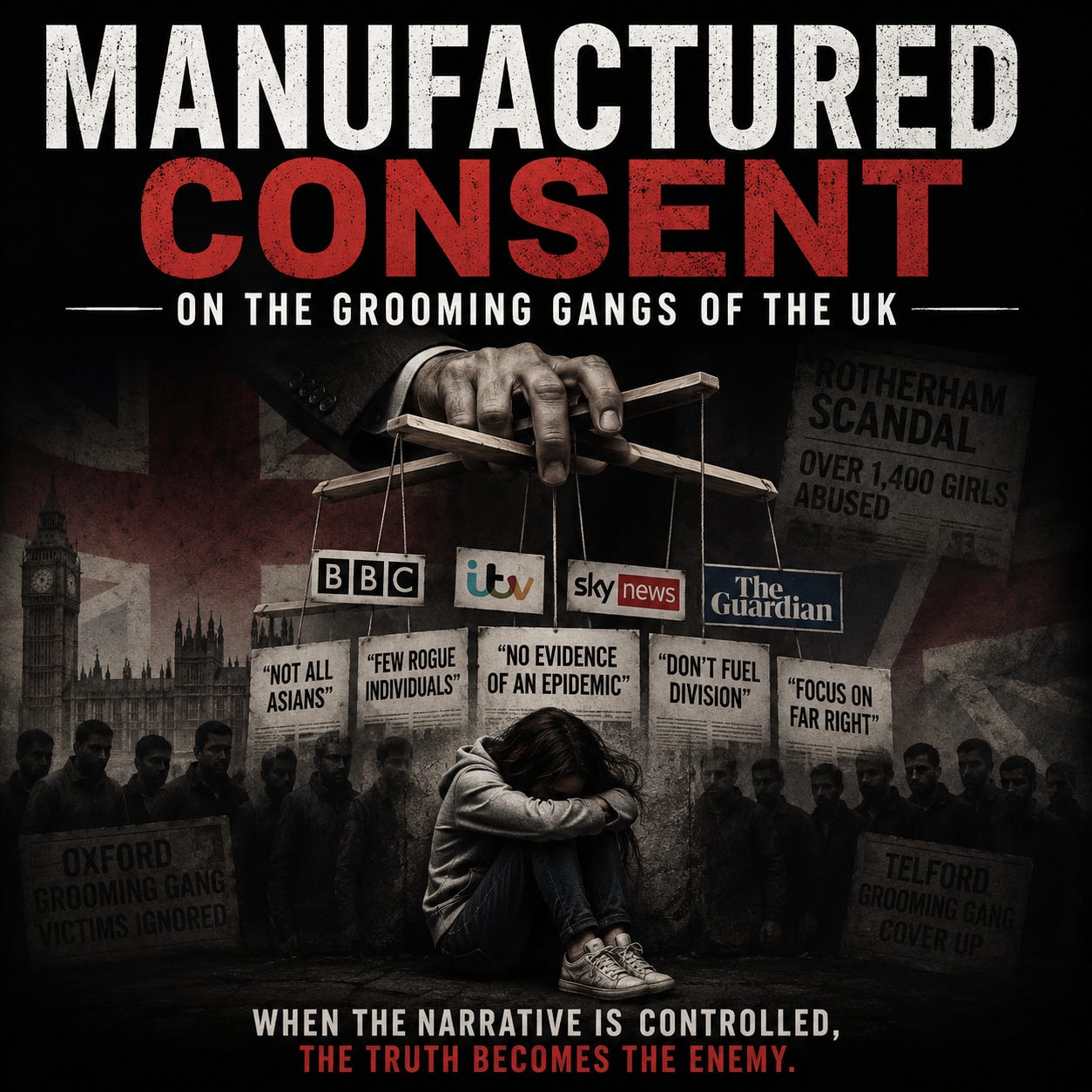
Political Choice Became Institutional Permission
In towns where Labour held power—Rotherham, Rochdale, Telford, and beyond—the party had built its electoral coalition partly on Muslim community support. That bloc was growing, it was reliable, and it was politically valuable. The grooming-gang crisis threatened that coalition. Not because decent Muslims wanted to protect rapists—they did not. But because politicians feared that acknowledging the ethnic and religious pattern would invite backlash, would splinter the coalition, would invite accusations that Labour was “Islamophobic.”
So they chose to suppress the data instead.
For decades, councils refused to record the ethnicity of offenders. Police forces were instructed not to highlight the pattern. When researchers tried to document it, they were blocked. When survivors tried to speak, they were told they were playing into the hands of the far right. The message was consistent: naming what was happening was more dangerous than allowing it to continue.
And in making that choice, the political class sent a message down through every institution: if the politicians will not confront this, then we should not either.
Political choice became institutional paralysis. Institutional paralysis became active enablement. The girls were sacrificed on the altar of electoral strategy.
The Architecture of Corruption
What emerges from the institutional record is not incompetence but a system.
Authorities were briefed and denied knowledge. Data was suppressed. Officers who tried to act were isolated and marginalised. Whistleblowers were suspended. Records were shredded. Operations investigating the abuse were shut down from above.
This was not accident. This was not the result of isolated bad decisions by individual actors. This was institutional policy, enforced from the top, designed to protect the reputation of the institution over the safety of children.
And the mechanism that made it possible was the same one that paralysed the frontline: the fear that confronting the pattern would invite accusations of racism, of Islamophobia, of political incorrectness. That fear, which started as institutional paralysis, became institutional policy. And policy, enforced from the top, becomes cover-up.
The corruption was this: every institution in the chain—from the police to social services to Parliament—made the same calculation. The cost of protecting institutional reputation was lower than the cost of confronting what had happened.
And once that calculation was made at the political level, it filtered down as permission. “If the politicians won’t act, institutions reasoned, we should not either. If the law is being used to silence us, we should be silent. If the cost of speaking is being labelled racist, we should not speak.”
The girls paid the price for that silence.
Part Two of this response to the “Rape Gang Report” will be published on Monday. exploring what needs to change.
Independent political analysis takes time and resources. To keep these articles free and accessible to everyone rather than locked behind a paywall, I rely entirely on voluntary reader support. If you value this work, please consider dropping a quick one-off tip in the coffee jar.
Amazing work. Great words, we keep pushing and shouting and sharing and praying. This is the biggest miscarriage of Justice in British History. Bless the girls.
The Nation and The People were, and are, continously betrayed by the politicians and bureaucracy of the various institutions. Time to clean them out.