
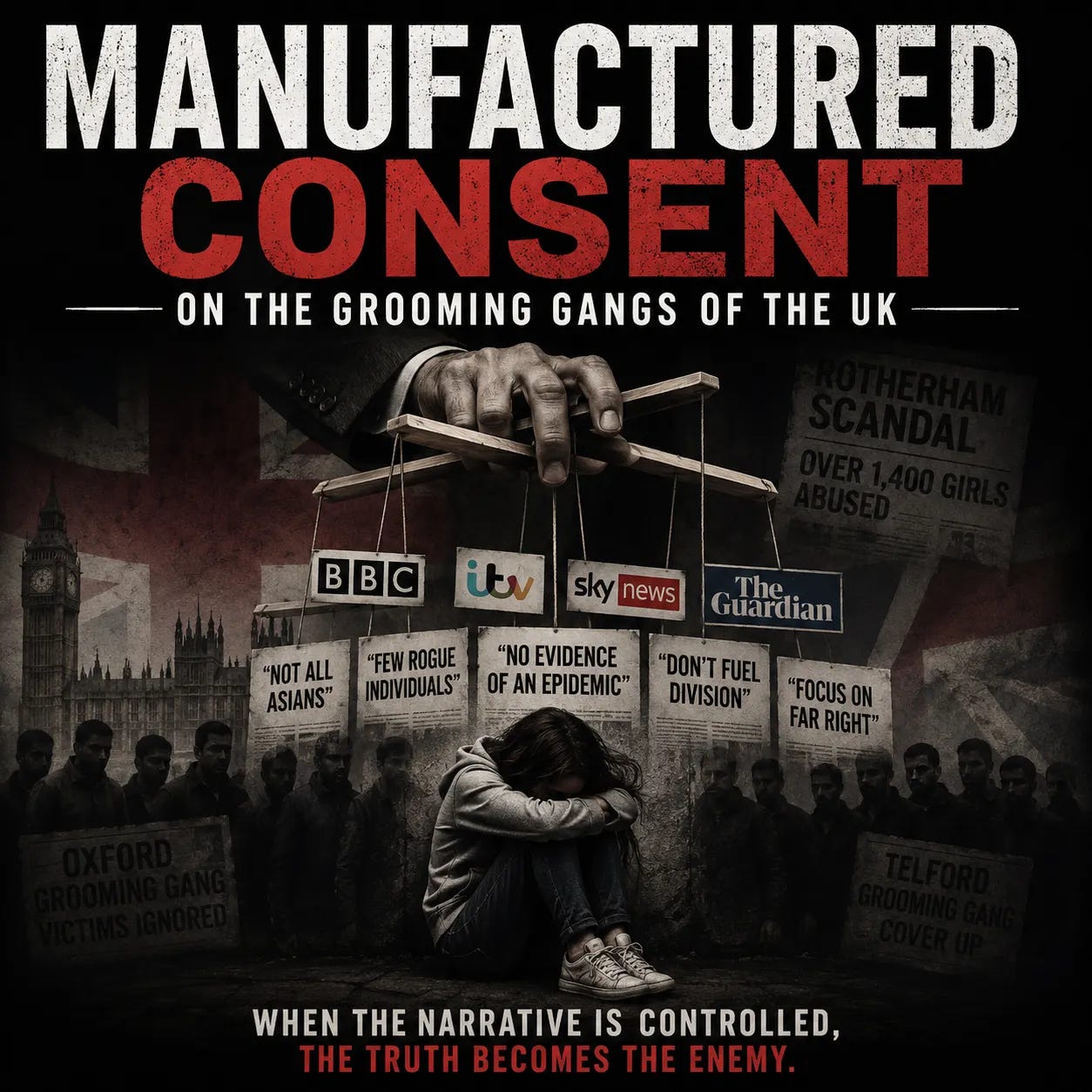
Manufactured Consent: The Architecture Behind Britain's Rape Gang Cover-Up Part Two
Part 2: What Must Change

The scandal did not happen by accident. Neither did its concealment. What the Lowe Inquiry documents is not institutional incompetence but institutional choice made deliberately, at the highest political level, by people who knew exactly what they were hiding and calculated it was worth the cost.
The Electoral Dependency as Linchpin
The political failure lies at the heart of the scandal. Successive governments lacked the will to confront the ethnic and religious patterns. The Labour Party bears particular responsibility.
In towns where Labour held power, the party had constructed its electoral coalition partly on Muslim community support. That bloc was growing, reliable, and politically valuable. Confronting the grooming-gang scandal—which was overwhelmingly perpetrated by men of Pakistani and Muslim heritage—threatened that coalition. Not because decent Muslims wanted to protect rapists, but because acknowledging the pattern invited accusations of Islamophobia and risked electoral backlash.
So they chose suppression instead.
For decades, councils refused to record the ethnicity of offenders. Police forces were instructed not to highlight the pattern. When researchers tried to document it, they were blocked. When survivors tried to speak, they were told they were playing into the hands of the far right.
The message was unmistakable: naming what was happening was more dangerous than allowing it to continue.
The report documents the cost of that choice: a quarter of a million children abused, while the party that could have acted chose to protect its electoral strategy instead.
The Refusal to Inquire
When public pressure finally forced the question of an inquiry, Labour’s response revealed the calculation plainly.
Initially, the party refused a public inquiry altogether. Only under considerable pressure did they relent. But when they did, they did so on their own terms: they produced a national inquiry whose “tightly drawn terms of reference deliberately excluded systematic examination of the demographic, cultural, and religious drivers.”
This was not oversight. It was design. The Lowe Inquiry notes it plainly: Labour ensured that the official inquiry would not ask the questions that mattered. Ethnicity as a driver. Religion as a factor. The deliberate suppression of data. The political cowardice. All of it was written out of the scope.
The message was unmistakable: we will have an inquiry, but only if it avoids the uncomfortable truth.
The Conservative Party, when in government, continued with Labour’s approach. They failed to impose mandatory ethnicity recording despite clear evidence from Rotherham and elsewhere. They launched no full statutory inquiry despite decades of documented abuse. When finally forced to move, they did so half-heartedly, with the same strategy: control the terms, limit the scope, avoid the pattern.
Both parties understood the same calculation. Confronting the reality—that the gangs were overwhelmingly Pakistani Muslim men, that the victims were overwhelmingly white working-class girls, that the paralysis was rooted in fear of being labelled racist—was politically too costly. Better to contain it, suppress it, reframe it, than to face it.
In January 2025, MPs voted down a national statutory inquiry by 364 to 111. The majority of Parliament voted to refuse an inquiry. It took a full U-turn months later—forced by the Casey Audit and public fury—before an inquiry under Baroness Longfield was produced.
But even that inquiry was designed to avoid every question that matters. The terms of reference were “drawn precisely to avoid the national scale, the ethnic and religious profile, the political cowardice.” Plans for five separate local inquiries were quietly dropped. Reportedly “to avoid offending Pakistanis.”
The message was clear: the apparatus of government would defend itself before it would defend the abused.
The Named Betrayal
The report does not leave the betrayal to implication. It names the names.
Lord Nazir Ahmed, former Rotherham Labour councillor, made a peer by Blair, convicted in 2022 of child sex offences including the rape of a 13-year-old. Jailed for five and a half years. He sat in the system. He knew. He was part of the machinery of suppression.
Shaun Wright, who kept his post as Rotherham’s lead for children’s services through the years the abuse was at its height. The report documents his knowledge, his position, his failure to act. He represented the institutional choice: protect the institution, not the children.
And the reported claim—never fully investigated—that on Sir Keir Starmer’s watch as Director of Public Prosecutions, some 13,000 suspected offenders were dealt with by warning letter rather than prosecution. Thirteen thousand. Not pursued. Not tried. Warned and released.
The scale of the political choice becomes clear when you see the numbers: decisions made not to prosecute, decisions made not to record, decisions made not to investigate. Each one a calculation that something else—reputation, votes, institutional standing—mattered more than justice.
Greater Manchester and Scotland: The Pattern Holds
Andy Burnham, Mayor of Greater Manchester, is held up as Labour’s defender—as one of the good ones. The evidence suggests otherwise.
His 2017 review confirmed that authorities had failed children across Manchester, Oldham and Rochdale. The findings were clear. The failure was documented. And then: not one officer was sacked. Not one pension was stripped. Not one person in a position of power was held to account.
Two reviewers resigned from the final phase of his inquiry. The reason: Greater Manchester Police “blocked” them from documents and survivors. The investigation was obstructed from within. And Burnham, who holds the power as Police and Crime Commissioner to prosecute officers who fail children, has not used it.
In the words of whistleblower Maggie Oliver, who has worked with him: when it came to “gripping what is going on now, he turned away.”
The betrayal is not only English. Scottish political parties refused a dedicated inquiry and failed to record offender ethnicity. The same choice, made in the same way, in a different part of the country. The political class, wherever it holds power, reaches for the same tool: suppress the data, narrow the inquiry, frame the problem as something other than what it is.
How the System Worked
Three elements, each reinforcing the others, created a closed system designed to enable abuse. Not by accident. By choice.
The Legal Foundation created the conditions. Decades of legal reform—the Race Relations Act, Macpherson, the Equality Act 2010, hate crime legislation—built a framework in which discussing ethnicity in crime patterns became professionally and legally hazardous. The framework was not neutral. It was designed to make silence safer than speech.
The Institutional Fear activated those conditions. Every institution—police, social services, schools, the NHS—internalised the message: confronting the pattern is dangerous. The risk to institutional reputation of being labelled racist outweighed the duty to protect children. Paralysis became policy. And policy, once established, became difficult to break.
The Political Calculation weaponised that fear. Labour, and later the Conservatives, made a deliberate choice: the electoral support of Muslim communities mattered more than the safety of white working-class girls. That choice filtered down through every institution. If the politicians will not act, institutions reasoned, we should not either. Political cowardice became institutional permission.
Together, these three created a closed system. Legal framework + institutional fear + political permission = a machinery designed to enable abuse while protecting the people responsible for it.
Why This Was Corruption
Corruption has a simple definition: the abuse of power for private gain. What happened here was corruption in exactly that sense—but the “private gain” was not money. It was institutional reputation, political survival, electoral strategy.
The people responsible for protecting children chose instead to protect themselves. They used the power vested in them—the power to investigate, to prosecute, to safeguard—not to discharge that duty but to evade it. They actively protected perpetrators. They criminalised victims. They suppressed evidence. They rewarded silence and punished whistleblowers.
And they did it knowing what they were doing. This was not negligence. This was choice.
Underneath all three elements sat a fourth: these children were disposable. White, working-class, often in care, already disbelieved by society. The kind of children institutions could afford to lose. If they had been middle-class, or from powerful families, or visibly connected to people who mattered, the response would have been different. But these children had no one. No bloc of voters to protect them. No political constituency. No power.
So they could be used. And when they were used up, they could be discarded.
That is the deepest corruption: the choice to value some lives more than others, and to use institutional power to enforce that hierarchy.
What Must Happen Now
The Lowe Inquiry’s recommendations are radical because they must be. The system that enabled this abuse will not reform itself. It will not voluntarily record ethnicity data. It will not prosecute its own officers. It will not confront the pattern that would require it to admit its failure.
Force is required.
On the legal front:
A new Childhood Sexual Exploitation Act creating a specific offence of organised group-based CSE, with life sentences as the starting point. Minimum tariffs of 50 years for ringleaders, 25 for participants. Cumulative sentencing, so the full weight of the crime is visible in the sentence.
“Sammy’s Law”—expunging the criminal records of children convicted of offences they committed while being coerced or trafficked. The state should not punish children for crimes committed against them.
A statutory duty to record the ethnicity, nationality, immigration status and religion of perpetrators and victims. Not optional. Not subject to local discretion. Mandatory. Criminal liability for officials who fail to comply or who suppress data “for community relations.”
Deportation of every foreign national convicted. Automatic loss of citizenship for dual nationals, applied retrospectively. The message must be unmistakable: this is not tolerated.
On the institutional front:
Investigation and, where culpable, closure of mosques, madrassas and community organisations that harboured or failed to report perpetrators. If institutions provided cover, they lose the right to operate.
Dedicated investigation of serving officers allegedly involved in the networks. External, independent, with power to prosecute and dismiss.
A national compensation scheme funded partly by the pensions of police and social workers found guilty of culpable negligence. The cost of institutional failure should be borne by the institution and its officers, not by the public purse.
A dedicated FCDO taskforce to locate, safeguard and repatriate British girls trafficked overseas—to Pakistan and elsewhere—to be controlled, silenced and abused beyond the reach of British investigators.
On the political front
Repeal or radical reform of the Human Rights Act 1998 and the Equality Act 2010 where they obstruct investigation of crime. The law should not be weaponised to protect perpetrators.
A ban on sharia marriages and sharia courts operating in Britain. If a legal framework provides cover for abuse, it should not be permitted to operate.
An inquiry into the knowledge and decisions of named politicians—not to create political theatre, but to establish whether criminal liability attaches. If politicians knowingly suppressed investigation of child abuse for electoral advantage, that is conspiracy. Conspiracy can be prosecuted.
On Accountability
The hardest recommendation is the one that matters most: accountability must be visible and consequential.
Not internal disciplinary processes that end in early retirement. Not quiet resignations. Not terms of reference drawn to avoid the uncomfortable questions. Real accountability, with real consequences: dismissal, prosecution, imprisonment where appropriate, loss of pension, public humiliation.
The people who made these choices need to understand that those choices have cost them their careers, their freedom, their reputation. The message must be unmistakable: the protection of children supersedes institutional loyalty. Always.
And the message must reach down through every institution: if you choose to protect the institution instead of the child, you will be held accountable. That threat is the only thing that will change behaviour faster than the legal requirement to change it.
Why This Matters Beyond the Girls
The system that enabled this abuse is not unique to this crime. It is the system that protects institutional reputation at the cost of justice across the public sector. It is the architecture of cover-up.
Where it succeeded with these girls, it has succeeded with other crimes. It has protected officers who brutalised detainees. It has protected social workers who abused children in their care. It has protected officials who knowingly failed in their duty. The same calculation—institutional reputation matters more than justice—runs through case after case.
Until that calculation changes, until the threat of accountability makes it costlier to cover up than to confront, the machinery will keep working. Different crimes, same paralysis. Different victims, same silence.
The Rape Gang Inquiry is not just about these 250,000 girls. It is a test case. If the institutions that enabled this abuse face real consequences, if the calculation changes, if accountability becomes real, then the system itself begins to shift.
If it does not—if the recommendations are diluted, if the terms of reference are narrowed, if the inquiries are contained, if the named officials face no consequences—then the message will be equally clear: do what you did before. The system will protect you again.
The Choice Ahead
Britain now has a choice. Not a difficult choice, but a clear one.
The Lowe Inquiry has documented what was done. It has named the names. It has laid out the recommendations. It has shown, in meticulous detail, what institutional corruption looks like when it prioritises reputation over justice.
The choice is whether to act on that knowledge or to do what the institutions did for fifty years: look away.
The girls did not get to look away. For decades, they were not permitted that mercy. They were forced to see, to endure, to suffer while the adults paid to protect them chose instead to protect themselves.
The least Britain can do is look. The most it can do is act.
What comes next is not about the inquiry. It is about whether the institutions—the police, social services, Parliament, the courts—have the courage to change. Not to reform themselves. To be reformed. To have accountability imposed on them from outside, with the threat of consequence if they resist.
That is what must follow.
The report is published. The evidence is in the public record. The choice is now.
Related Content Part One of this Manufactured Consent Report
Independent political analysis takes time and resources. To keep these articles free and accessible to everyone rather than locked behind a paywall, I rely entirely on voluntary reader support. If you value this work, please consider dropping a quick one-off tip in the coffee jar.
Excellent piece of first class journalism 👏
This is how it should be done. Clear. Consise. No ambiguity. And finally the pathway forward.