

Orwell’s Warning: Fabianism and the Starmer State

George Orwell chose his emblem carefully when he wrote *Nineteen Eighty-Four*. Whether the title was a reversal of 1948, the year he wrote it, or a deliberate reference to the centenary of the Fabian Society’s founding in 1884, the message was unmistakable. A socialist himself, Orwell had looked at the trajectory of Fabian thought—gradualist, technocratic, administered from above by middle-class intellectuals who claimed to speak for the working class but had never lived among them—and seen where it would lead.
Tyranny
Not the boot-stomping, revolution-in-the-streets kind. The polite kind. The managed kind. The kind that arrives through policy papers and statutory instruments, delivered by people in good suits who talk about “public service” and “the common good” while centralising power, criminalising dissent, and building the surveillance apparatus that makes a free society impossible.
Orwell was warning us. We did not listen. And now, less than two years into Sir Keir Starmer’s government, we are living through precisely the authoritarian slide Orwell predicted—delivered, as he knew it would be, by the very Fabians who now occupy every lever of power in Downing Street.
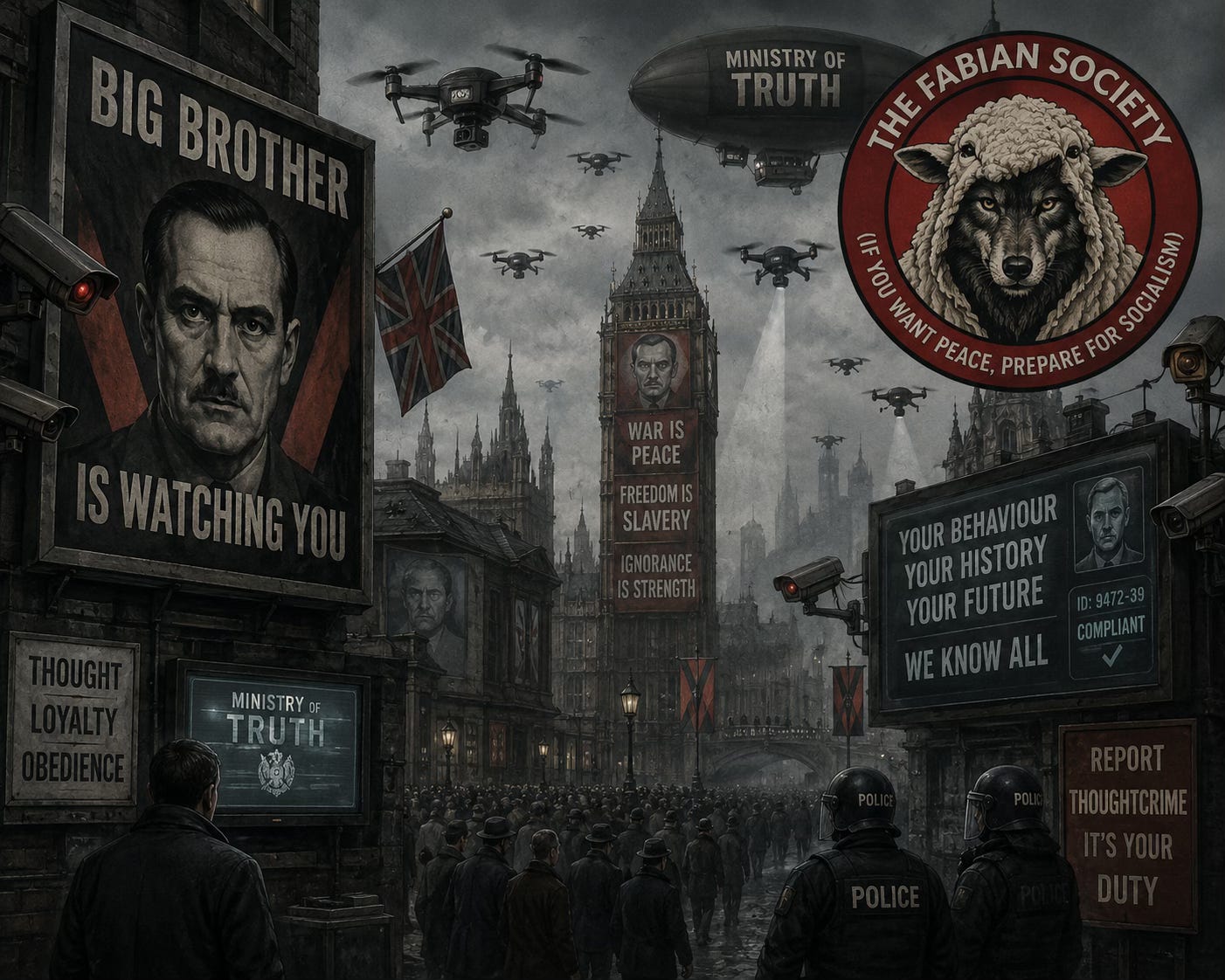
The Fabian Society’s own logo tells you everything you need to know. It is a wolf in sheep’s clothing. Not a metaphor. An actual wolf, dressed in wool, adopted as the official emblem of an organisation founded in 1884 to bring about socialism through gradual reform rather than revolution. Stealth, not force. Subversion, not confrontation. The Society has never denied this. They have worn it proudly for a hundred and forty years.
And Orwell, who spent his adult life as a socialist, despised them for it.
What Orwell Actually Said About Fabianism
In 1937, Orwell published *The Road to Wigan Pier*, a two-part work that began as a commissioned report on the condition of miners in northern England and ended as a searing indictment of the middle-class socialists who claimed to represent them. The second half of the book—often skipped by readers uncomfortable with its conclusions—is where Orwell’s critique of Fabianism becomes explicit and unsparing.
He described them as “intellectual, tract-writing … high-minded Socialist slum visitor[s]” who had no actual affinity for the working class they purported to champion. Their socialism, he argued, was not about improving the lives of ordinary people. It was about control.
“The truth is that, to many people calling themselves Socialists,” Orwell wrote, “revolution does not mean a movement of the masses with which they hope to associate themselves; it means a set of reforms which ‘we’, the clever ones, are going to impose upon ‘them’, the Lower Orders.”
This was Orwell’s central accusation against Fabianism: that it was a movement of bourgeois intellectuals using the language of social justice to accumulate power over people they neither understood nor respected. The Fabians claimed to speak for the working class. Orwell had lived among miners, slept in their lodgings, eaten their food. He knew the claim was a lie.
“I have known numbers of bourgeois Socialists,” he wrote, “I have listened by the hour to their tirades against their own class, and yet never, not even once, have I met one who had picked up proletarian table-manners.”
The contempt drips from the page. Orwell was not attacking socialism. He was attacking socialists—specifically, the kind who thought socialism meant a cadre of educated elites making decisions on behalf of a working class they had never joined and did not trust.
Seventy years later, those socialists run Britain. And the machinery they are building looks uncannily like the one Orwell described in *Nineteen Eighty-Four*.
This Fabian Labour Cabinet
The Fabian Society itself boasts that “every Labour prime minister has been a Fabian” and that “more than half” of Starmer’s Cabinet are members. This is not speculation. It is their own claim, published on their website and repeated in their literature.
Sir Keir Starmer is a long-standing Fabian. He served on the Society’s executive committee before entering Parliament. In September 2021, he published a pamphlet for the Fabian Society titled *The Road Ahead*, setting out his vision for government. The title itself is telling—a deliberate echo, perhaps, of Orwell’s *Road to Wigan Pier*, though one doubts Starmer caught the irony.
Angela Rayner, until her resignation in September 2025 over a stamp-duty breach, was Deputy Prime Minister and a Fabian member. David Lammy, now Deputy Prime Minister and Lord Chancellor, is a Fabian who co-authored the Society’s 2023 foreign-policy pamphlet *Britain Reconnected*. Rachel Reeves, the Chancellor, is a former member of the Fabian executive and has edited collections of Fabian essays.
This is not a coalition government. It is a Fabian government. The ideology that Orwell warned against—gradualist, technocratic, administered by middle-class intellectuals convinced of their own superior wisdom—is now the operating system of the British state.
And the policies that government has pursued since July 2024 are a textbook demonstration of why Orwell was right to be afraid.
Surveillance: The Telescreen Comes to Britain
In Orwell’s *Nineteen Eighty-Four*, the telescreen is the instrument of total surveillance. It watches. It listens. It records. The Party knows where you are, what you say, who you associate with. Dissent becomes impossible because privacy no longer exists.
In September 2025, the Starmer government announced it would pursue a controversial Digital ID scheme, required to prove one’s right to work and potentially extendable to other areas of life such as right-to-rent checks. At the same time, it confirmed the expansion of Live Facial Recognition (LFR) technology to every police force in England and Wales, including a large fleet of mobile surveillance vans capable of scanning crowds in real time.
This was not a proposal. It was not a trial. It was a rollout.
Live Facial Recognition was deployed at the Notting Hill Carnival in August 2025. Police in London and across the UK now routinely film protests, with footage of “a public order event without targeted individuals” stored for up to six years—or, if it contains “intelligence,” potentially for decades.
The telescreen has arrived. It does not sit in your living room. It drives through your streets in a van, scanning your face as you walk past. And the Fabian government, which came to power promising “change,” has chosen not to reverse the surveillance state built by the Conservatives but to expand it.
Statewatch, a civil-liberties organisation, published an analysis in April 2026 titled *The Decline of Rights Under UK’s Labour: 2024-2026*. Its conclusion was unequivocal: “Despite Prime Minister Keir Starmer promising that change would ‘begin immediately’, under his watch the government has continued, and at times intensified, a crackdown on civil liberties begun by his Conservative predecessors. The result is more surveillance, greater potential for police abuse and the criminalisation of nearly all meaningful forms of protest.”
Orwell knew that surveillance was not an end in itself. It was a means. The end was obedience.
Criminalising Dissent: Thoughtcrime by Another Name
In *Nineteen Eighty-Four*, the crime of “thoughtcrime” is not the act of rebellion. It is the thought of rebellion. The Party does not wait for dissent to manifest in action. It crushes it at the level of intention. To think against the Party is to commit a crime.
Britain has not yet criminalised thought. But it has come dangerously close to criminalising the peaceful expression of it.
Since Labour took power in July 2024, the government has retained every anti-protest law introduced by the Conservatives under the Police, Crime, Sentencing and Courts Act 2022 and the Public Order Act 2023. It has not rolled them back. It has expanded them.
In January 2026, Human Rights Watch published a report titled *Silencing the Streets: The Right to Protest Under Attack in the UK*. Based on research conducted throughout 2024 and 2025, it documented that “protesters are increasingly detained, charged, and in some cases sentenced to multi-year prison terms for non-violent actions such as attending planning meetings.”
The starkest example: five Just Stop Oil activists were sentenced in July 2024 to between two and five years in prison for joining a Zoom call to plan a protest. Not for blocking a road. Not for damaging property. For joining a Zoom call.
On appeal, the High Court ruled in March 2025 that the sentences were “manifestly excessive” and disproportionate. It reduced them—marginally. One activist’s sentence was cut from five years to four. That is still longer than many violent criminals serve.
The government’s response? To introduce the Crime and Policing Bill 2025, which proposes further restrictions on protest, including a blanket ban on face coverings at demonstrations and expanded police powers to restrict gatherings near places of worship.
The Terrorism Act 2000, originally designed to combat political violence, has been repurposed to target peaceful protesters. In August 2025, a 57-year-old woman named Emma Kamio was arrested under the Terrorism Act, held for five days, and subjected to what she described as “psychological torture” for her involvement in climate activism.
Human Rights Watch’s conclusion: “The UK is now adopting protest-control tactics imposed in countries where democratic safeguards are collapsing. The UK should oppose such measures, not replicate and endorse them.”
Orwell would not have been surprised. In *The Road to Wigan Pier*, he warned that Fabian socialism was fundamentally about imposing order on people who did not share the values of the educated elite. The protesters being jailed today—environmentalists, Palestinian-rights campaigners, anti-lockdown activists—are precisely the kind of people the Fabians have always viewed with suspicion: ordinary citizens who refuse to defer to their betters.
The Labour government defends this crackdown in the language of “law and order.” Starmer, the former Director of Public Prosecutions, has revived Tony Blair’s slogan: “Tough on crime, tough on the causes of crime.”
But the “crime” being punished is dissent. And the cause of that crime, in the government’s eyes, is a refusal to accept the wisdom of those who know better.
Newspeak: The Sanitisation of Power
Orwell’s Newspeak was not simply propaganda. It was the deliberate narrowing of language to make dissent literally unthinkable. If the words to express a thought do not exist, the thought itself becomes impossible.
The Starmer government has not rewritten the dictionary. But it has adopted a linguistic strategy so carefully managed, so relentlessly on-message, that it achieves much the same effect.
Consider the government’s relentless use of the phrase “fixing the foundations.” Starmer deploys it constantly — in speeches, in press conferences, in response to every criticism of his government’s record. The country wants faster change? We’re “fixing the foundations.” The economy is contracting? We’re “fixing the foundations.” Public services are collapsing? We’re “fixing the foundations.”
The phrase is Newspeak in its purest form. It makes disagreement sound unreasonable. If the government is “fixing” something, then opposition to its policies becomes opposition to repair itself. Who, after all, is against fixing broken things?
But the foundations being “fixed” never seem to improve. Tax rises are “fixing the foundations.” Cutting winter fuel payments is “fixing the foundations.” The largest tax increase since 1993 is “fixing the foundations.” The phrase has become a rhetorical shield — a way of framing every unpopular policy as necessary medicine that only the short-sighted would refuse.
Orwell understood that the corruption of language was not incidental to authoritarianism. It was foundational. If the state can control how you describe reality, it can control how you think about it. And a government that describes every failure as “fixing the foundations” has learned that lesson well.
The same pattern appears in the government’s handling of protest. Demonstrators are not citizens exercising their democratic rights. They are “disruptors” causing “serious disruption” to “the life of the community.” The language makes the protester, not the cause of the protest, the problem.
When the courts ruled that the Conservative government’s definition of “serious disruption”—lowered by Suella Braverman to mean “more than a minor disturbance”—was unlawful, the Labour government appealed the decision. It lost again in May 2025. The Court of Appeal confirmed the regulations were unlawful.
The government has not repealed them. As of this writing, they remain in force, void in law but operationally active. Police continue to arrest protesters under provisions that have been ruled illegal.
Orwell understood that the corruption of language was not incidental to authoritarianism. It was foundational. If the state can control how you describe reality, it can control how you think about it.
The Media: Manufacturing Consent
In *Nineteen Eighty-Four*, the Ministry of Truth rewrites history. Yesterday’s news is altered to match today’s Party line. The past becomes whatever the Party says it was.
Britain has not reached that point. But the mainstream media’s handling of the Starmer government suggests we are moving in that direction—not through state coercion, but through a shared ideological ecosystem that makes certain stories unthinkable to pursue.
Labour’s 2024 manifesto contained a single paragraph on media policy. It promised to “work constructively” with the BBC and public service broadcasters. That was it. No commitment to reversing fourteen years of cuts. No promise to end political interference in BBC governance. No vision for protecting press freedom.
Since taking office, the government has presided over another round of redundancies and closures at BBC News. The BBC World Service—once funded by the Foreign Office—has shed 130 jobs and closed several programmes. The Labour government, like its Conservative predecessor, insists the BBC must fund the World Service from the licence fee.
The government held a private meeting with Elbit Systems, the Israeli arms manufacturer, in December 2024. A recording was made. Both parties have refused to release it. The meeting was revealed only through a Declassified UK investigation published in March 2025.
None of this has generated sustained coverage from the outlets that spent fourteen years scrutinising every Conservative misstep. The BBC, ITV, Channel 4, the *Guardian*—the institutions that pride themselves on holding power to account—have treated the Starmer government with a deference they never extended to Boris Johnson or Rishi Sunak.
Why? Because, as Orwell understood, the media class and the political class are not separate. They are drawn from the same universities, the same postcodes, the same social circles. They share the same assumptions. And when the government in power is one they spent years campaigning for, the instinct to protect it overrides the duty to scrutinise it.
This is not conspiracy. It is structural bias. And its effect is the same: a government operating with less accountability, less transparency, and less fear of public backlash than any in recent memory.
Where This Leads
Orwell did not write *Nineteen Eighty-Four* as a prediction. He wrote it as a warning. The world he described was not inevitable. It was a possibility—one that could be avoided if people recognised the mechanisms of tyranny before they became entrenched.
Britain in 2026 is not Oceania. We do not yet live under a totalitarian regime. But the architecture is being built. The surveillance. The criminalisation of protest. The narrowing of acceptable speech. The media’s selective blindness.
And it is being built, as Orwell warned it would be, by well-meaning socialists who believe they are acting in the public interest.
The Fabian Society’s gradualism was always its greatest strength and its greatest danger. Change imposed slowly, through incremental reform, does not feel like tyranny. It feels like progress. Each new regulation, each expansion of state power, each restriction on civil liberties is justified as necessary, proportionate, reasonable.
But tyranny does not arrive in a single dramatic moment. It arrives in a thousand small steps, each one individually defensible, cumulatively irreversible.
Starmer’s government has taken office with a mandate for “change.” What it is delivering is continuity—the continuation of a surveillance state, the continuation of a protest crackdown, the continuation of policies its members spent years opposing when they were implemented by Conservatives.
The only thing that has changed is who holds the power. And that, Orwell knew, was the point.
The Fabians do not want revolution. They want control. They do not want to empower the working class. They want to manage it. And the machinery they are building—Live Facial Recognition vans, five-year prison sentences for Zoom calls, Digital ID schemes, anti-protest laws that criminalise “more than minor” disruption—is the machinery of a state that no longer tolerates dissent.
Orwell’s warning was not about the inevitability of tyranny. It was about the ease with which good people, convinced of their own righteousness, could build it without realising what they were doing.
The wolf is wearing wool. It always has been. The emblem told us so. And now the wolf is in Downing Street, surrounded by other wolves, all of them insisting they are sheep.
Orwell tried to warn us. Will we listen before it is too late?
**Sources**: Statewatch, *The Decline of Rights Under UK’s Labour: 2024-2026* (April 2026); Human Rights Watch, *Silencing the Streets: The Right to Protest Under Attack in the UK* (January 2026); George Orwell, *The Road to Wigan Pier* (1937); Fabian Society publications; UK Parliament records; BBC, ITV, *Guardian*, *Independent*, and other UK media sources referenced throughout.
If you'd prefer to support the work with no commitment, you can buy me a coffee.
Terrifyingly apt. We, British patriots, cannot survive another 3 years of this Labour government. There will be nothing left of our once great country, being ruined on a daily basis. Is there no one of honour in this country’s establishment who will stand up and be counted, stand up and defend the majority population of Britain from the evil of this current Labour government. We need a principled version of ‘Gina’, the wealthy lawyer who took Boris to Court…..someone who knows all of the levers to pull to defenestrate the entire Labour benches and push for a new election NOW. This government is in power by default….it has ignored all manifesto promises and continues to attempt to force us back into the EU without another referendum and ignore Parliamentary democracy….running the country as a dictatorship…and all with a mandate formed by votes of just 20% of the electorate. The official opposition party are complicit in many of the anti democratic laws being put in place….they truly are the UniParty, whatever they may say to try to appease the public. The Party with the maximum support in the country has, by a twist of the FPTP voting system, just 8 MP’s - despite massive support in the country. The whole system is bent in such a way that our country is dying before our eyes - killed by a bunch of socialist nonentities with a proven useless ideology……and strangely enough these front bench ministers who spout socialism are extremely wealthy people who have no concern for working people whatsoever - unless of course they are working for the State. The sickness in this country starts at the top and it needs to be removed by any means possible.
The only antidote to Fabianism is contained in a book published in 1962: "Capitalism and Freedom" by Milton Friedman.
https://en.wikipedia.org/wiki/Capitalism_and_Freedom