

The Argument Against Moderate Muslim's Is Just Lazy.

Someone needs to say this plainly: when you claim “there are no moderate Muslims,” you’re not making a bold statement about Islam. You’re making a confession about your own reasoning. And it’s not a flattering one.
Let me be clear: This doesn’t change my views on what has happened to this country one jot. Nor what needs to happen. It is borne out of me seeing the hate towards people like Zia Yusef who is one of the most effective speakers for Reform UK that they have, and who, IMHO is more patriotic than Keir Starmer and many white British politicians ever will be.
Let me show you why
The Problem With Your “No Moderate Muslim’s” Argument Is That You Already Know It’s Wrong
Flip the religion and you’d see it instantly.
David Koresh. Jim Jones. Warren Jeffs.
You know these names. You know what they did. Koresh burned his compound and 76 people with it—25 of them children. Jones orchestrated the mass murder-suicide of over 900. Jeffs ran a system of child marriage and systematic abuse under the banner of Mormon theology.
They quoted scripture extensively. They built their movements explicitly on religious foundations. They attracted followers who considered themselves devout believers.
And when we discussed these horrors, did anyone seriously argue “there are no moderate Christians”? Did anyone claim that David Koresh represented the spiritual core of Christianity, and the other two billion adherents were somehow the aberration?
Of course not. We understood instinctively that extremists don’t represent the mainstream. That text interpretation varies wildly across believers. That radicalisation is driven by psychology, by isolation, by charismatic leadership—by a thousand factors that have nothing to do with theology.
We understood all of that. We understood it so completely we didn’t even have to think about it.
And then Islam entered the conversation, and suddenly we forgot how to think.
So Let’s Apply the Same Standard We’d Apply to Our Own Religions
Here’s what we’d say about David Koresh’s Christianity, if we were being intellectually honest:
- Extremists don’t represent the mainstream
- Text interpretation varies across believers
- Cultural and psychological factors drive radicalisation beyond theology
- Millions practice their faith peacefully
- Condemning an entire religion for its worst adherents is intellectually dishonest
That’s not a controversial position. That’s basic logic. That’s what you’d defend if someone tried to argue that Koresh proved Christianity was fundamentally violent.
Yet when it comes to Islam—when we’re talking about 1.8 billion people across dozens of countries with radically different cultures and governance systems—we throw that logic away entirely. And I don’t think it’s because the argument is genuinely weaker. I think it’s because somewhere along the way, consistency became less important than certainty. Fear is easier than nuance. And if you’ve already decided Islam is the problem, moderate Muslims become inconvenient. They complicate the story you’ve told yourself.
ISIS didn’t emerge from Islamic theology any more than the Branch Davidians emerged from the Book of Revelation. ISIS emerged from a specific political context: the collapse of state authority in Iraq and Syria, decades of Western military intervention, the absence of legitimate channels for political opposition, and the availability of territory and resources. Give those same conditions to Christian extremists, Buddhist extremists, or secular fascists, and you get similar results.
That’s not an excuse. It’s an explanation. And understanding the difference matters.
Here’s What Drives Religious Extremism Across All Faiths
Charismatic leadership and the demand for absolute obedience. Whether it’s Abu Bakr al-Baghdadi or Jim Jones, extremist movements coalesce around individuals who claim special divine insight and brook no dissent.
Isolation and control. From Waco to Raqqa, the mechanism is identical: separate followers from mainstream society, control their information, control their relationships. They dictate who you can speak to, what you’re allowed to hear, how you understand the world outside. By the time someone is truly isolated, they’re not evaluating ideas anymore. They’re just obeying.
Scriptural cherry-picking and unaccountable leadership.
All extremists selectively emphasise certain texts while ignoring others, rejecting centuries of mainstream theological interpretation. That’s how you move from “thou shalt not kill” to the Branch Davidians, and from “no compulsion in religion” to the Taliban. It happens because there is nobody with the authority or the will to stop them.
The difference between religious moderation and religious extremism is not the underlying faith. It’s geopolitics, governance, education, economic opportunity, and the presence or absence of secular institutions that provide checks on religious authority.
It’s everything except the theology.
The Moderate Muslim Reality Is That It’s Completely Normal
I don’t need to cite studies to tell you what you already know. You work with Muslims. You have Muslim colleagues. Your doctor might be Muslim. The person who served you coffee this morning might be Muslim.
And they are, by every measure that actually matters, as moderate as any Presbyterian or Methodist in your neighbourhood.
They don’t support terrorism. They don’t support theocracy. They condemn violence against civilians. They want the same things for their children that you want for yours.
This isn’t contentious. This is observable reality.
Are there theological debates within Islam that make some Westerners uncomfortable? Absolutely. Just as there are ongoing debates within Christianity about women’s roles, LGBTQ rights, and religious authority. Religion is messy. It evolves. Believers pick and choose—all believers, across all faiths.
The Muslim serving in your military, teaching in your schools, practising medicine in your hospitals is as moderate as any adherent of any other major world religion. The claim that such people don’t exist doesn’t make them disappear. It just reveals the intellectual bankruptcy of the person making the claim.
Why This Matters
When we declare “no moderate Muslims exist,” we do three things. All of them damaging.
We alienate natural allies in the fight against actual extremism. The people best positioned to oppose Islamist terrorism are Muslims themselves—theologians, community leaders, ordinary believers who understand the tradition well enough to argue against those who distort it. Zia Yusuf has the platform. He speaks clearly and powerfully about extremism. And yet people dismiss him anyway. Not because his argument is wrong. Because he’s Muslim.
That dismissal is often dressed up in theology. The concept of Taqqiya gets invoked—the claim that Islam permits Muslims to lie to non-believers, that anything a Muslim says in defence of their faith is potentially deception, that trust is therefore impossible. It sounds scholarly. It isn’t.
Here’s what Taqqiya actually is. It is a narrow emergency doctrine, recognised in classical Islamic law, that permits a believer to conceal or deny their faith when facing severe persecution, torture, or the imminent threat of death. That’s it. It says nothing about lying in daily life. It says nothing about deceiving non-believers as a strategy. It is an extreme exception for extreme circumstances—not a principle, not a virtue, and not a licence for anything beyond survival.
And here’s what Islam actually teaches outside that narrow exception: honesty. The prohibition on lying in Islam is not ambiguous or qualified. It is foundational. Most Muslim scholars treat Taqqiya the way most Christian scholars treat just war theory—as a theoretical limit case that has no bearing on how ordinary believers live their lives. The Muslims condemning terrorism today are not engaging in Taqqiya. They are doing what their faith actually requires of them. Using a distorted version of an obscure doctrinal exception to dismiss every Muslim voice isn’t theological sophistication. It’s motivated reasoning with a Wikipedia gloss on it.
We confirm the extremist narrative that the West is at war with Islam itself, not with terrorism. That’s the recruitment pitch, right there. ISIS didn’t gain followers by claiming to represent Islam. It gained followers by claiming that the West hated Islam, and that moderate Muslims were traitors to their own faith. Every time we insist moderate Muslims don’t exist, we prove their point for them.
We abandon intellectual honesty. We apply a standard to Islam we would never accept applied to our own religion. We know that David Koresh didn’t prove Christianity is inherently violent. We know that Warren Jeffs doesn’t speak for Mormonism. We know that the institutional abuse of children by Catholic clergy is not a feature of Christian theology. Yet somehow, when a jihadist organisation acts in Islam’s name, suddenly the entire faith is guilty of its extremes.
That’s not rigour. That’s prejudice dressed up as pattern recognition.
What Opposition to Extremism Actually Looks Like
You can oppose Islamist extremism vigorously while acknowledging that most Muslims reject it.
You can oppose honour killings, female genital mutilation, apostasy laws, and theocratic governance fiercely while recognising that millions of Muslims already live peacefully in pluralistic societies.
You can be tough on terrorism without being stupid about theology.
The claim that moderate Muslims don’t exist isn’t brave truth-telling. It’s lazy thinking dressed up as boldness. It’s the intellectual equivalent of claiming there are no moderate Christians because the KKK quotes the Bible.
We should be better than that. And if we’re not—if we can’t manage basic consistency in how we reason about religion—then we’re not actually interested in opposing extremism.
We’re just interested in being right about Islam.
Which is something else entirely.
So What Now?
If you’ve read this far and you’re still unconvinced, that’s fine. But be honest about what you’re doing. You’re not defending truth. You’re defending a narrative. And narratives are comfortable—they don’t require you to think, to hold nuance, to admit that the world is more complicated than your argument needs it to be.
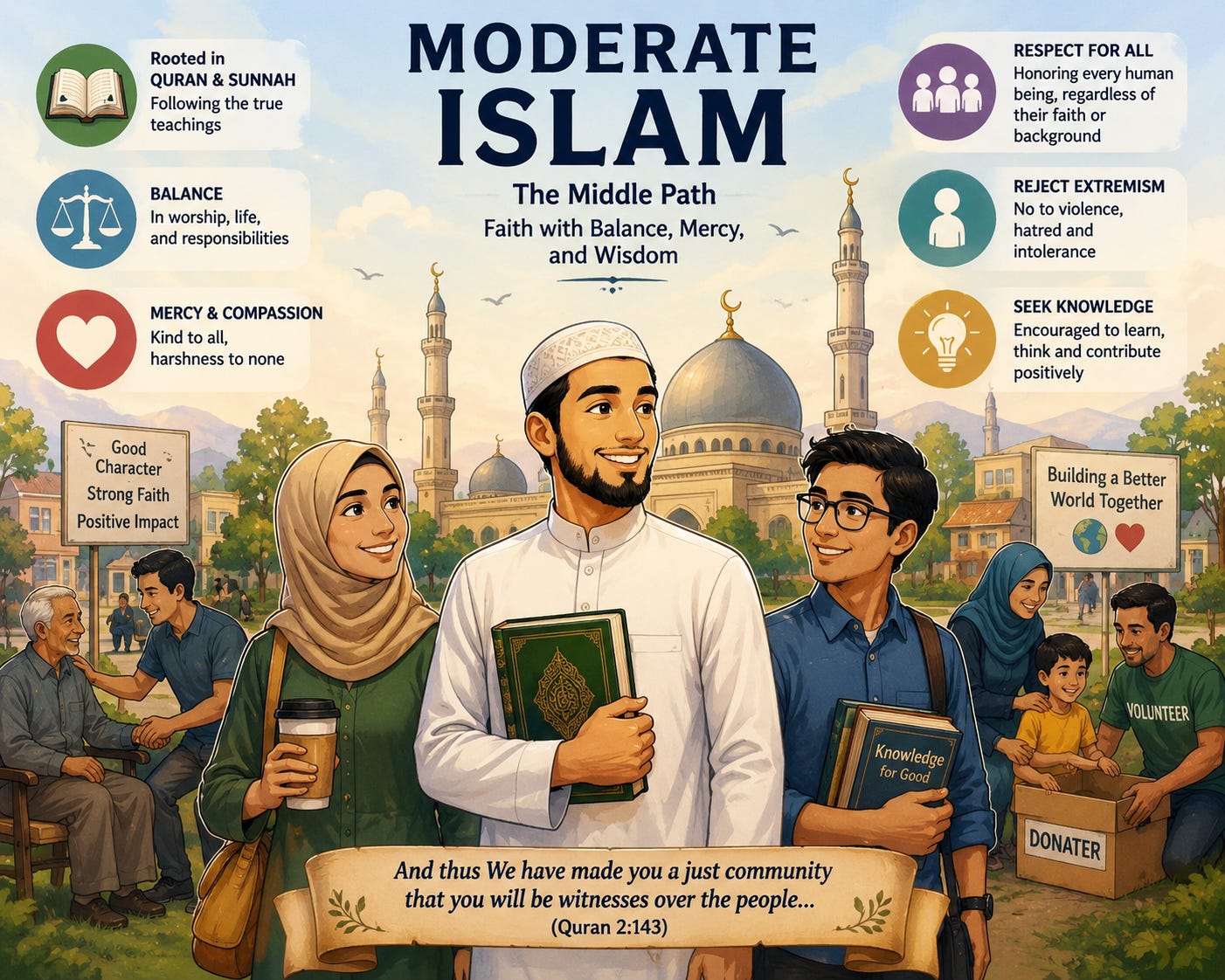
Here’s what changes if you decide to actually apply consistent logic:
You stop dismissing Muslim voices that criticise extremism. You listen to Zia Yusuf not as a curiosity or a convenient exception, but as exactly what you claim doesn’t exist—a Muslim who understands his own tradition well enough to argue powerfully against those who distort it.
You stop treating 1.8 billion people as a single monolith and start recognising the profound theological and political differences that exist within Islam. A secular Muslim in London has more in common with a secular Christian in Birmingham than either has with a fundamentalist of their own faith.
You start asking harder questions—about geopolitics, about state collapse, about the conditions that produce extremism regardless of which holy book gets invoked to justify it.
And most importantly, you admit that the argument “there are no moderate Muslims” is not a sophisticated analysis. It’s intellectual laziness with a microphone. And you decide to do better.
That’s not asking you to go soft on extremism. It’s asking you to be honest about what extremism actually is, where it comes from, and who is best placed to fight it.
The moderate Muslims are already doing that work. Who's going to be in charge of deportations and the hardest removal rules we have seen regarding that for decades? Zia Yusef.
The question is whether you’re willing to be intellectually honest and willing to see and to hear him?
Prefer a One Off Contribution?
The Roman Catholic sex abuse scandal is very comparable. You can count on it that every priest that molested a child was seen as a holy man of god by his parishioners. But no one tars the entire Christian church with the same brush.
Excellent article very well put, in any religion you get good and bad, you will always have people who put their own interpretation on what is written. This does not mean they all have the same views or condone what others with extreme views do.