

Britain did not abolish free speech in 2003. It did something more effective. It created a legal framework that has steadily expanded the state’s ability to regulate, monitor and police expression.
The pattern is visible. Each law, viewed in isolation, can be justified on its own terms. Together, they represent a gradual shift in the relationship between the citizen, the state and the digital public square.
One that should concern every one of us.
2003: THE FOUNDATION – COMMUNICATIONS ACT
When Tony Blair’s government passed the Communications Act 2003, it was presented as a modernisation of Britain’s communications and broadcasting framework. It created Ofcom. It updated telecommunications regulation for a changing technological age.
Harmless enough. On the surface.
Buried within the Act was Section 127. It made it a criminal offence to send, by means of a public electronic communications network, a message that was ‘grossly offensive or of an indecent, obscene or menacing character.’
Two words matter here: ‘grossly offensive.’
The term was not precisely defined in statute. It has instead been shaped through judicial interpretation. Whether a communication crosses the threshold is determined by courts applying legal tests developed through case law.
Not Parliament. Not a clear definition. Courts. Making it up as they go.
The law was drafted before the explosion of modern social media. What had been conceived in an era dominated by traditional telecommunications networks would later be applied to online platforms and social media services. A law built for one world was weaponised in another.
One of the most famous cases was that of Paul Chambers, who in 2010 posted a joke on Twitter about blowing up Robin Hood Airport after his flight was disrupted. He was prosecuted under Section 127. His conviction was eventually overturned on appeal. But the case established something far more significant: communications sent via platforms such as Twitter fell within the scope of the legislation.
A joke. A prosecution. A precedent.
As social media became central to public discourse, Section 127 increasingly became a tool for policing online communications. That was not an accident. That was the architecture working as designed.
2016: THE SURVEILLANCE LAYER – INVESTIGATORY POWERS ACT
Thirteen years later, Parliament passed the Investigatory Powers Act 2016.
It was called the ‘Snoopers’ Charter.’ The name fits.
The legislation consolidated and expanded a range of surveillance powers that had previously existed across multiple legal frameworks. It provided a legal basis for the retention of communications data. It authorised various forms of interception and equipment interference. It created mechanisms for the collection of data for national security and law-enforcement purposes.
The government argued it brought transparency and oversight to powers that already existed. What it actually did was normalise mass surveillance and grant the state unprecedented access to citizens’ digital lives.
The Act introduced the ‘double lock’ system. Many warrants would require approval from both a Secretary of State and an independent Judicial Commissioner. Oversight. Accountability. Safeguards.
The words sound reassuring. The reality is different. The scale of data collection and retention created risks to privacy and freedom of expression that no oversight mechanism can fully contain.
The Act increased the legal capacity of public authorities to obtain information about online activity and communications. That is not a matter of interpretation. That is what it did.
And here is the connection that matters. Surveillance powers and speech offences do not exist in separate boxes. The greater the state’s ability to identify online activity, the easier it becomes to enforce laws governing online expression.
Build the watchtower first. Then pass the laws about what people can say. The sequence is not a coincidence.
2023: THE ONLINE SAFETY ACT
The Online Safety Act 2023 was introduced as a response to online harms, particularly those affecting children and vulnerable users. It was developed under the Conservative government and received Royal Assent in October 2023.
Protecting children. No one argues against that. Which is precisely why it makes such effective cover.
Among its provisions were new criminal offences relating to online communications.
Section 179 created the offence of sending false communications. A person who knowingly sends false information intending to cause non-trivial psychological or physical harm is guilty of a criminal offence.
Section 181 created the offence of sending threatening communications. Threats of death, serious injury, rape, assault by penetration or serious financial loss. Maximum sentence: five years’ imprisonment.
Five years. For a message.
These offences do not generally operate retrospectively. Criminal offences in the United Kingdom are not ordinarily applied to conduct that occurred before the relevant provisions came into force. That is established legal principle.
But the Online Safety Act did not replace existing communications offences. It added further tools to the legal framework already available to prosecutors. Section 127 still stands. The Malicious Communications Act still stands. The new offences sit on top of the old ones.
More tools. More charges. More ways to prosecute.
The pattern is consistent. Each law does not replace the last. It builds on it.
2024: THE MEDIA ACT
The Media Act 2024 addressed a different question: the changing media landscape.
Traditional public service broadcasters—the BBC, ITV, Channel 4, Channel 5, STV and S4C—increasingly faced competition from streaming services and online platforms. The audiences were leaving. The viewing figures were falling. The relevance was diminishing.
The Act introduced new prominence requirements. Public-service content must remain easily discoverable on connected television platforms and similar services.
The stated justification was that public-service broadcasters perform an important democratic and cultural function. They should not disappear beneath recommendation algorithms designed around commercial engagement.
That sounds reasonable. Until you examine what it actually established.
The principle. The principle that government can require certain forms of content to be given preferential visibility. Not because audiences chose it. Because the state decided it mattered more.
The immediate focus was television and streaming services. The broader question—the one that should have set alarm bells ringing—was whether similar principles might eventually be applied elsewhere.
They would be. Within two years.
2026: THE NEXT STEP
In 2026, policymakers moved to the next phase. How should public-service media operate in a digital environment increasingly dominated by global technology platforms?
The reality driving the debate is simple. Younger audiences consume far more content through social-media and video-sharing platforms than through traditional broadcasting. The BBC is losing the battle for attention. The state wants to fix that. Not by making better content. By changing the rules.
Proposals under discussion explored whether public-service content should receive greater visibility on digital platforms. Whether ‘trusted’ news sources could be made prominent in an environment shaped by recommendation algorithms.
‘Trusted.’ Defined by whom? The government.
The justification is familiar. Misinformation is spreading. Trust in institutions is declining. Consumption habits are changing. Something must be done.
Something is always the answer. And something always means more control.
The other side of the equation is stark. Government involvement in determining which content receives preferential treatment distorts the marketplace of ideas. It disadvantages independent creators and publishers. It tells the public what to watch, what to read, what to trust.
The debate remains unresolved. But it represents a significant shift in thinking about the relationship between public-service media and algorithm-driven platforms. A shift towards control. Not away from it.
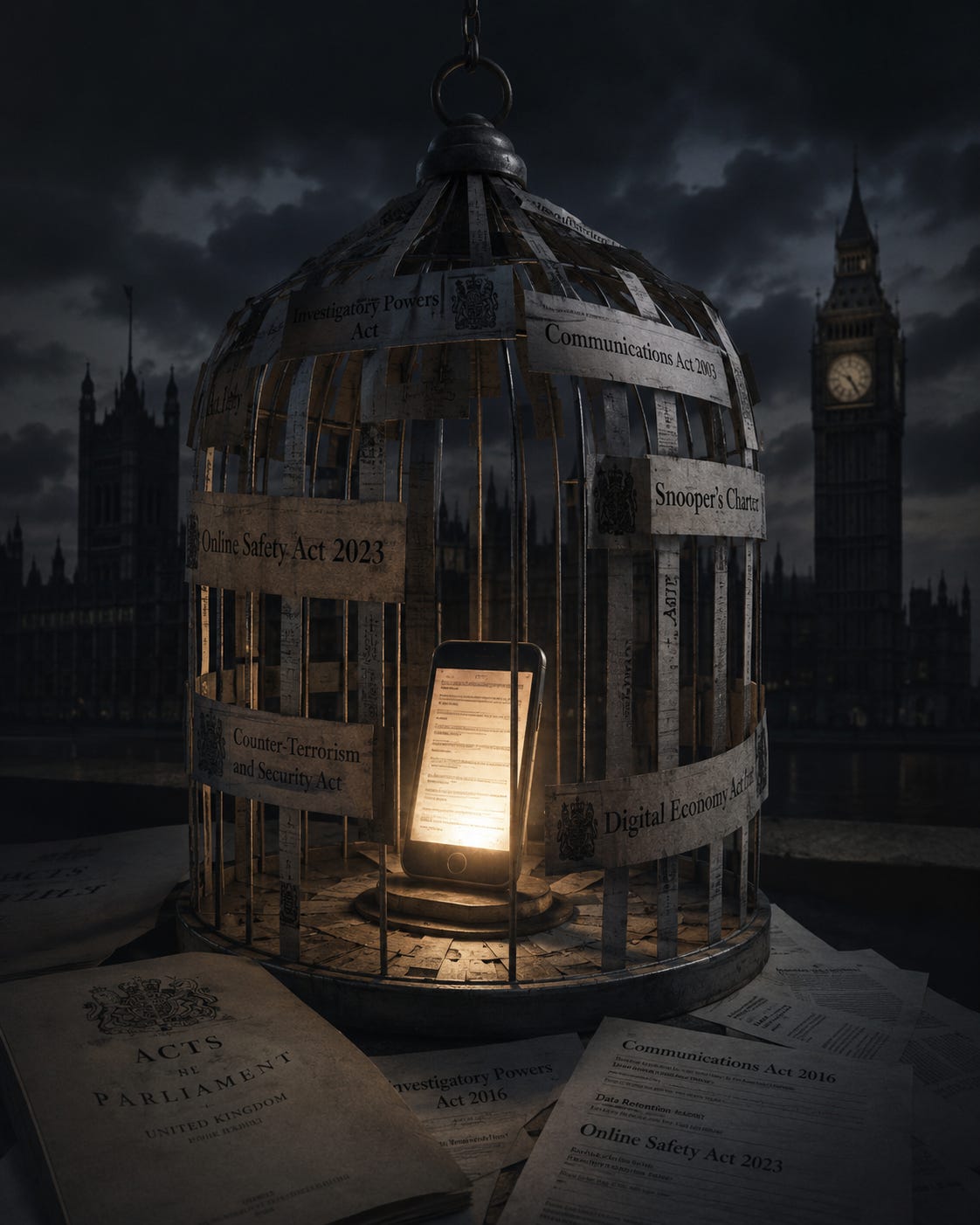
THE CAGE BUILT ONE BAR AT A TIME
Each of these measures was introduced for a different purpose. That is the design. That is what makes it work.
The Communications Act addressed offensive communications. The Investigatory Powers Act addressed national security and law enforcement. The Online Safety Act addressed online harms. The Media Act addressed the future of public-service broadcasting.
Different problems. Different justifications. Different debates. But the same direction of travel.
First came broad communications offences. Vague language. Wide application.
Then came expanded surveillance powers. The infrastructure to see everything.
Then came new online-speech offences. Sharper tools. Higher penalties.
Then came legislation requiring greater visibility for designated media providers. The state deciding what you should see.
Each step enabled the next. Each one looked reasonable on its own. Together, they form something else entirely.
THE REAL QUESTION
The debate is not about a single law. It never has been.
It is about where the balance lies between freedom and regulation in a digital society.
How much power should governments possess to police online communications? How much visibility should the state be able to guarantee for particular institutions? How much authority should platforms exercise over public discourse?
And who decides where the line is drawn?
These questions are not theoretical. They sit at the heart of modern democratic life.
The argument is not over whether governments should regulate the digital world. They already do.
The argument is over how far that regulation should go. And whether citizens are paying sufficient attention as new powers—however well-intentioned—accumulate over time.
Because that is how it works. Not with a single dramatic act. Not with a moment the public can point to and say: that is when it changed.
It happens gradually. Incrementally. One reasonable-sounding law at a time.
And by the time you notice the cage, the door is already shut.
Sources include: The Telegraph, Policy Exchange Think Tank, Watch This Space Green Paper.
Related: Orwell’s Warning: Fabianism and the Starmer State
Independent political analysis takes time and resources. To keep these articles free and accessible to everyone rather than locked behind a paywall, I rely entirely on voluntary reader support. If you value this work, please consider dropping a quick one-off tip in the coffee jar or if you can afford it become a paid subscriber.
This country is becoming too Orwellian to live in. I hate, loathe and despise the Tory and especially Labour parties for what they continue to do to our once wonderful country. Fabianism should be proscribed and wiped off the face of the earth - an anti patriot ideology by a bunch of total wnkrs with no care or love of our country, just a burning desire to make us all subjugated to their ‘superior….ie ‘progressive’ view of what is suitable. Which is actually just making sure that THEY are the pigs in charge and we are the peasants doing their bidding. Resist, resist, resist my fellow patriots….how can the inadequates in Labour EVER presume to be superior, they are just bullies - and bullies always are just hiding their own lack of worth.
If anyone still needs a reason for Tories or Labour to never be in power this is it. Whole system needs tearing down.