


Farage, Reform and the Question Westminster Cannot Answer
There is a pattern playing out across the Western world.
When a political movement challenges the authority of the governing class, the response follows a sequence so predictable it could be scripted.
First, the movement is ignored.
Then it is ridiculed.
Then it is denounced.
And when none of that works, attention shifts from the arguments to the people making them.
The movement is scrutinised. Its leaders are investigated. Its supporters are smeared. Its legitimacy is questioned.
We have seen it in the United States. In France. Across Europe.
And increasingly, millions of voters believe they are watching it unfold in Britain.
The political establishment dismisses that claim immediately. It insists that investigations are simply investigations, scrutiny is simply scrutiny and accountability is simply accountability.
Perhaps.
But the question being asked is not whether politicians should face scrutiny. Of course they should.
The question is why scrutiny so often intensifies at the precise moment an anti-establishment movement begins threatening the political status quo.
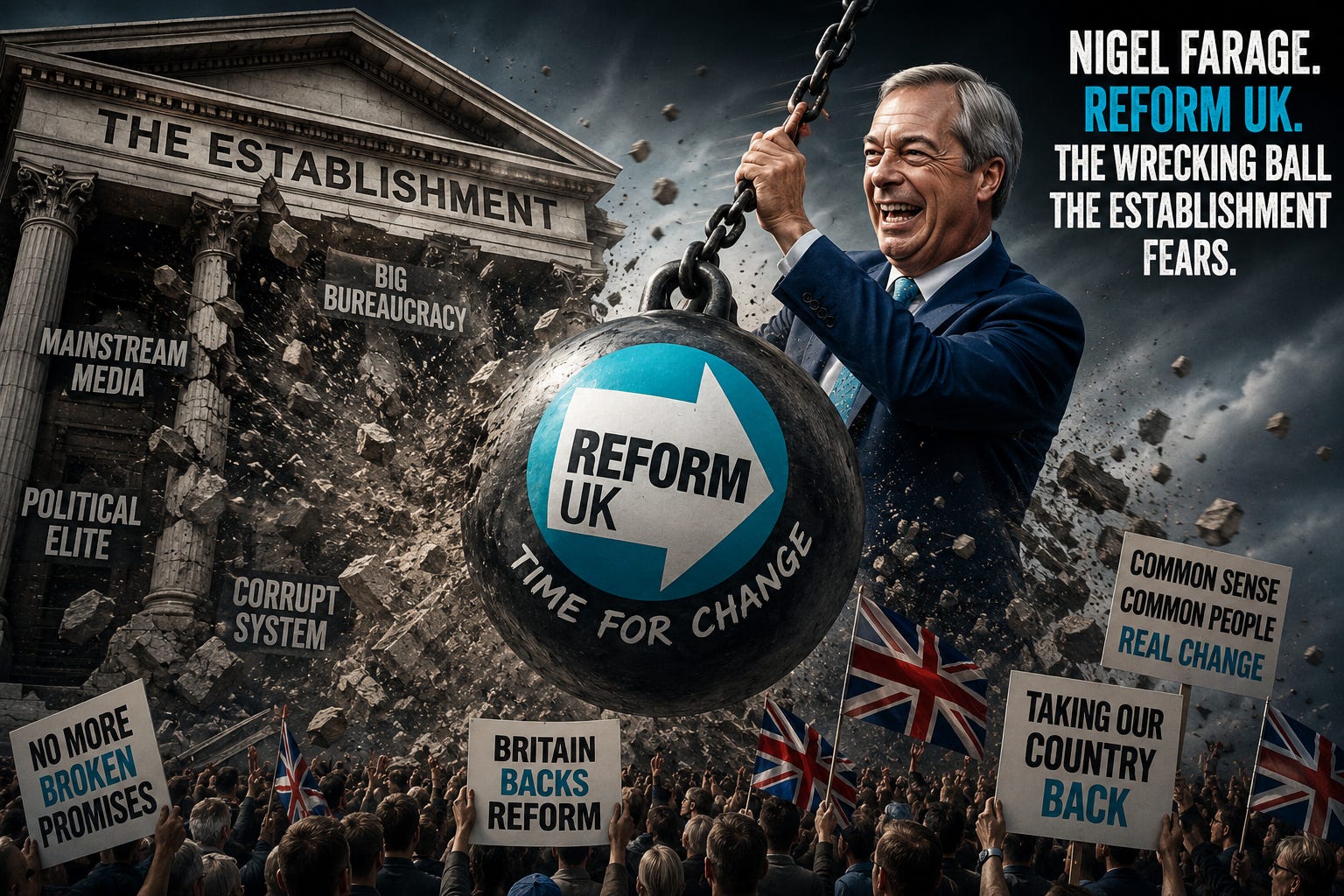
That is the question hanging over Nigel Farage and Reform UK.
Westminster appears unable — or unwilling — to answer it.
The Crisis Westminster Created
The rise of Reform UK is routinely explained as the product of one man’s personality.
That explanation is convenient. It allows the political class to pretend the problem is a man rather than a movement.
It is also wrong.
Reform’s growth is rooted in something the governing class refuses to confront: the collapse of public trust in the institutions that run Britain. A collapse those same institutions engineered.
The promises were made by successive governments. Both parties. For decades.
Immigration would be brought under control.
Economic growth would improve living standards.
Housing would become more affordable.
Public services would become more efficient.
Communities would become safer.
The results speak for themselves.
Net migration hit 944,000 in the year ending March 2023 — the highest figure in recorded history. Home buyers under 35 now account for barely 10% of all homeowners in England. The tax burden reached 36.1% of GDP in 2025/26 and is forecast to hit 37.7% by 2027/28 — the highest level since records began in 1948. NHS waiting lists peaked at 7.8 million in September 2023 and still stood at 7.22 million in April 2026 — against a pre-pandemic baseline of 4.4 million. The A&E four-hour treatment target has not been met nationally since July 2015.
Every one of those numbers represents a broken promise. Every broken promise chipped away at public trust. And every government that inherited the mess repeated the same pledges, delivered the same failures and expressed the same surprise when voters stopped believing them.
The public did not suddenly become angry.
The public was given reasons to become angry.
They were told the economy was strong while struggling to make ends meet. They were told immigration was under control while watching the numbers climb. They were told public services were improving while waiting longer and paying more.
Eventually, millions of people reached a conclusion.
The people making the promises had stopped telling the truth.
That is the foundation upon which Reform UK was built.
Not charisma. Not populism. Not clever campaigning.
Distrust. The kind of distrust that develops when institutions repeatedly fail and then refuse to acknowledge those failures.
The political establishment continues to frame Reform as the problem.
Reform is not the problem. Reform is the reaction.
Labour and the Conservatives created the conditions. The civil service helped sustain them. Much of the media helped ignore them.
And now the same establishment that spent years dismissing public concerns seems genuinely surprised that millions of voters have gone looking elsewhere.
It should not be surprised.
The warning signs were everywhere. The Brexit vote. The collapse of party loyalty. Record levels of political distrust. Growing support for parties outside the mainstream.
These were not isolated events. They were symptoms.
And every attempt to portray Reform supporters as misguided, uninformed or manipulated reinforces the very argument Reform is making.
The political class keeps attacking the messenger.
Because confronting the message would require confronting its own failures.
Reform Changes the Equation
For decades, Westminster operated under a simple assumption: no matter how angry voters became, power would remain in the hands of Labour or the Conservatives.
Governments changed. Prime Ministers came and went. But the duopoly endured.
That assumption is now under serious strain.
Year Long polling has repeatedly placed Reform UK ahead of both Labour and the Conservatives. Last month YouGov data found 61% of Britons now view Reform as a ‘main party.’
Whether those numbers translate into parliamentary seats remains to be seen. But that is no longer the most important question.
The important question is why millions of voters are willing to consider it at all.
For the first time in modern British political history, an openly anti-establishment party is being discussed not as a protest movement, but as a potential party of government.
That changes everything.
Political movements stop being amusing when they become competitive. They stop being tolerated when they start threatening power itself.
For years, Nigel Farage was treated as a political curiosity. A broadcaster’s dream. A columnist’s punchline. A convenient figure for Westminster to mock whenever it wanted to demonstrate its moral superiority.
The establishment was perfectly comfortable with Farage when he appeared incapable of winning.
It became less comfortable when he helped deliver Brexit.
It became nervous when millions of voters kept following him afterwards.
And it became genuinely alarmed when Reform started drawing support from Labour and Conservative voters simultaneously.
That is what makes Reform different. It is not simply damaging one side of British politics. It is challenging the entire political settlement.
Labour sees votes leaking. The Conservatives see votes leaking. Safe seats no longer look quite so safe.
And Westminster is being forced to confront a possibility it never believed it would face: what happens if voters stop choosing between Labour and the Conservatives altogether?
That question terrifies people whose influence depends upon the existing system surviving largely unchanged.
Because Reform’s rise is not simply an electoral challenge. It is a challenge to the legitimacy of the political consensus that has governed Britain for decades. A consensus on immigration. On net zero. On multiculturalism. On Britain’s relationship with supranational institutions.
A consensus that large sections of the electorate increasingly reject.
The Referrals and the Questions
Recent allegations involving Nigel Farage have generated intense media coverage.
Questions have been raised regarding financial support linked to Christopher Harborne and separate support reportedly associated with George Cottrell. Farage denies wrongdoing and maintains that parliamentary rules were not breached. The relevant processes are ongoing.
No politician should be beyond scrutiny. No public figure should be exempt from investigation. That is not the argument.
The argument is about confidence.
Because many Reform supporters do not see a single investigation. They see a familiar sequence.
A political movement gains momentum. Its support rises. Its electoral prospects improve. Its opponents become alarmed.
And scrutiny intensifies.
Media coverage expands. Political attacks multiply. Demands for investigations grow louder. Every allegation becomes front-page news.
To those supporters, the timing is impossible to ignore.
The establishment’s response is predictable: the rules are the rules. Investigations are investigations.
On the surface, that argument is reasonable.
The problem is that millions of voters no longer accept institutional assurances at face value.
They have watched too many failures. Too many scandals. Too many double standards. Too many occasions where one rule appeared to apply to ordinary people and another to those in positions of influence.
And once that confidence is lost, every investigation becomes political. Every referral becomes controversial. Every allegation becomes another chapter in a larger story.
A story no longer about one man.
A story about whether the institutions exercising power still possess the legitimacy required to command public trust.
The International Pattern
If Britain were the only example, this argument would carry far less weight.
It is not.
Across Europe and North America, the same political dynamic has played out over the past decade. Different countries, different constitutions, different legal systems. The same pattern.
France
Marine Le Pen spent decades being dismissed as an extremist leading an irrelevant fringe. Election after election, National Rally’s support grew. The establishment’s response was not to address the concerns driving that support. It was to increase pressure on Le Pen herself. Criminal proceedings relating to misuse of European Parliament funds resulted in conviction and penalties. The French establishment pointed to the verdict as proof that accountability was working. Millions of French voters saw something different entirely — not necessarily because they believed the court was wrong, but because they had already stopped trusting the institutions involved. The numbers tell the story: Le Pen took 17.9% in the first round of 2012, 33.9% in the 2017 run-off and 41.5% in the 2022 run-off — 13.3 million votes. In March 2025, she was convicted of misusing EU funds, sentenced to four years and banned from holding public office for five years. Her support did not collapse. It continued to grow.
The Netherlands.
Geert Wilders was treated as a political outlier for years. His views on immigration and integration were considered beyond the boundaries of respectable opinion. He faced legal challenges, relentless criticism and sustained political opposition. The expectation was straightforward: enough pressure would marginalise him. Instead, his support endured. Then it grew. The more fiercely he was opposed, the more his supporters became convinced he was challenging something larger than individual policies. In 2021, the PVV held 17 seats in the 150-seat House of Representatives. In the November 2023 election, it won 37 — more than doubling its representation and becoming the largest party in parliament for the first time. 2.3 million Dutch citizens voted for the party the establishment had spent years trying to marginalise.
Italy.
Matteo Salvini built his career around migration, border security and national sovereignty — issues affecting millions that much of Europe’s governing class preferred to downplay. Predictably, investigations followed. Legal challenges followed. Political hostility intensified. His opponents called it accountability. His supporters called it confirmation.
The United States.
No modern politician illustrates the phenomenon more dramatically than Donald Trump. Investigations, impeachments, civil cases, criminal prosecutions — an extraordinary level of institutional attention unlike anything in modern American politics. Every indictment became a rallying cry. Every prosecution became a fundraising opportunity. Every legal battle became another chapter in a story his supporters already believed: that an entrenched establishment was determined to stop an outsider from returning to power. Despite years of unprecedented scrutiny, Trump returned to the White House. Not because the controversies did not matter. But because millions of voters had stopped trusting the people telling them why they should.
The details change. The countries change. The personalities change.
The pattern remains remarkably consistent.
An outsider challenges the consensus. Support grows. Institutional pressure follows. Supporters become more convinced. Trust deteriorates further. The cycle repeats.
And once enough voters begin viewing institutions through that lens, every subsequent event reinforces the suspicion.
Every investigation becomes evidence. Every prosecution becomes evidence. Every regulatory action becomes evidence.
The establishment sees separate events.
Supporters see a pattern.
And patterns, once established, are extraordinarily difficult to break.
The Credibility Collapse
The political establishment faces a dilemma of its own making.
If institutions investigate anti-establishment figures, supporters see political persecution. If they remain silent, opponents demand action. If they intervene, they are accused of bias. If they refuse, they are accused of negligence.
There is no escape from this trap.
Because the real problem is not any individual investigation. The real problem is that the establishment continues to behave as though public trust remains intact.
It does not.
For decades, institutions benefited from an assumption that their motives were broadly honourable. People may not have agreed with every decision. But they generally believed the system was operating in good faith.
That assumption has been eroded. Not by conspiracy theories. Not by social media. Not by populist politicians.
By failure.
Failure to secure borders. Failure to deliver economic prosperity. Failure to protect vulnerable children. Failure to control public spending. Failure to keep promises that were made repeatedly and broken repeatedly.
The Ipsos Veracity Index — the longest-running trust survey in Britain, conducted annually since 1983 — found in November 2025 that just 9% of Britons trust politicians to tell the truth. Nine per cent. That is the joint-lowest figure in the survey’s entire 42-year history. Only 14% trust government ministers. Trust in the police fell to 51% — also the lowest since 1983. Among Reform UK supporters, trust in judges, civil servants and TV news readers was lower still.
The establishment treats each decline as a separate problem.
They are all symptoms of the same disease.
A crisis of legitimacy.
And the media faces the same reckoning. Journalists present themselves as neutral observers holding power to account. That role is essential. But public confidence in the press has fallen dramatically. Many voters no longer believe scrutiny is applied evenly. They see intense coverage when anti-establishment figures face allegations. They notice a different level of urgency when failures emerge within the establishment itself.
Whether that perception is fair matters less than the fact it is now widespread.
Because the authority of every institution — political, legal, regulatory, journalistic — ultimately depends upon public trust.
And trust, once lost, does not return on demand.
The Question That Refuses to Go Away
The debate surrounding Nigel Farage was never really about Nigel Farage.
Farage is simply the latest figure at the centre of a much larger confrontation. A confrontation between an increasingly distrustful public and an increasingly defensive political establishment.
That is why every controversy involving him attracts such extraordinary attention. Because beneath the headlines, beneath the allegations and beneath the political point-scoring lies the question Westminster has spent years trying to avoid.
Why are so many voters abandoning the parties, institutions and voices that once dominated British public life?
Why has confidence fallen so dramatically?
Why are millions of citizens looking at the political class and concluding that it no longer understands the country it governs?
These are not questions about Nigel Farage.
They are questions about Britain.
The establishment can launch investigations. It can commission inquiries. It can produce reports. It can condemn, ridicule and attack those challenging its authority.
None of those things address the underlying problem.
A crisis of trust that has been building for years and that no amount of institutional reassurance can resolve — because institutional reassurance is precisely what voters have stopped believing.
The danger for Westminster is not Reform UK.
The danger is the possibility that millions of voters have stopped believing what Westminster tells them.
If that has happened — and the evidence increasingly suggests it has — then this debate is only beginning.
Because political parties can be replaced. Politicians can be replaced. Governments can be replaced.
But when trust in the system itself collapses, the consequences reach far beyond any election.
Reform UK did not create that crisis.
It inherited it.
And until Britain’s political class confronts that simple fact honestly, Reform’s rise is unlikely to be the end of the story.
It may simply be the beginning.
Related: The Lie The Establishment Will Now Tell You About Thursday
Independent political analysis takes time and resources. To keep these articles free and accessible to everyone rather than locked behind a paywall, I rely entirely on voluntary reader support. If you value this work, please consider dropping a quick one-off tip in the coffee jar.
Excellent article, every attack & insult thrown at Farage & Reform is attacking & insulting supporters, who they think will go back & vote for them if Farage & Reform are discredited. They have not learned anything, taking those voters for idiots is the biggest mistake they have made, it has shown them for what they are, underhand, corrupt, and detested by a vast amount of the population. Tories cannot erase the 14 years of mismanagement no more than Labour can erase the past 2 years or the repeating of history from previous Labour governments. This is not just the establishment against Reform and Farage, its the establishment against the people of this country.
Superb description of the truth of what is happening to politics. The fury felt by Reform supporters as they watch everything but the kitchen sink being thrown at Farage - whilst at the same time the MSM gives absolutely no content to the disgrace of Labour. It is common knowledge that Burnham is up to his neck in the cover up of rape gangs in the Manchester area, whilst he was the mayor, AND the Crime Commissioner. It is well known that Manchester had the lowest improvement in the country when Burnham was in charge. Skyscrapers through a cosy relationship with a single builder, whilst people still sleeping on the streets. New buses - linked to his wife’s business. His one ministerial role under Brown - Health Dept - was a disaster. He is a grifter and a fake. And he is being allowed to just walk into power, anointing the MP who stood down to allow this with the position of Head of Policy - no quid pro quo there then! And do we really think his mythical No.10 in the north will actually even up the country? Another day, another grift…just keep smiling and the plebs will fall for it….but just wait until I get into No.10, then they will learn I’m not really Mr NiceGuy. And maybe, just maybe, the MSM would like to do a complete audit and fact check on the actual balance sheet of the slippery, sleazy Miliband - he who prefers not to answer for anything before committees over what he is doing to the country’s wealth/energy supply /safety/food production/industry. Who made that arrogant prick into god?
And STILL the MSM bow down to a party system destroying our country. Is it any wonder that the citizens of GB don’t believe anything the ‘establishment’ say. We, the indigenous people, are actually living with the results of their sins and we do not believe one word of anything they say anymore. And Kemi makes her statements - which everyone yawns at because they are pointless guff from an irrelevant party led by a diversity choice. The “progressives”, “elites”, “ establishment” treat us like fools. We, and Reform, wait to bury them all.