

The “Surge” That Wasn’t: Why Restore Britain Is Going Nowhere Fast
An analysis of Rupert Lowe’s new party and the inconvenient gap between hype and reality

There are people across right-wing media — step forward, Dan Wootton and friends — who have spent recent weeks breathlessly telling us that Rupert Lowe’s Restore Britain is surging. Revolutionary. Unstoppable. The next great force in British politics. So it must be a touch embarrassing that the first proper, independent, nationally recognised poll to include them has put Restore Britain at just 4%.
Not exactly the stuff of democratic revolutions, is it?
Let’s look at how we got here — and why the numbers are heading in precisely the wrong direction.
The Polling: From Hype to Reality
The story of Restore Britain’s polling is essentially the story of what happens when you commission your own polls and then confuse them with reality.
Back in November 2024, hypothetical polling — asking “would you vote for any party led by Rupert Lowe?” — put him at around 10%. Promising, on paper.
When Lowe formally launched Restore Britain as a political party in February 2026, a snap survey by Find Out Now — commissioned by Restore Britain itself — put the party at 10% of the vote. Lowe was jubilant. He posted on X: “10%. In 24 hours. I call that a bloody good start.” The right-wing commentariat duly lost their minds with excitement.
There was just one small problem. Critics pointed out that Rupert Lowe simply doesn’t have the profile or wider brand recognition to be pulling these numbers, suggesting that most of his supporters were “frequent social media users.” In other words: very online people, very detached from the actual electorate.
Sure enough, a Find Out Now poll of over 3,000 adults in late February found 7% support for Restore Britain, with their backing coming primarily from non-voters and former Reform and Conservative voters — and with their strongest age group being 18–29-year-olds at 11%. The youth surge! Tremendous! Except those are also the people least likely to actually vote.
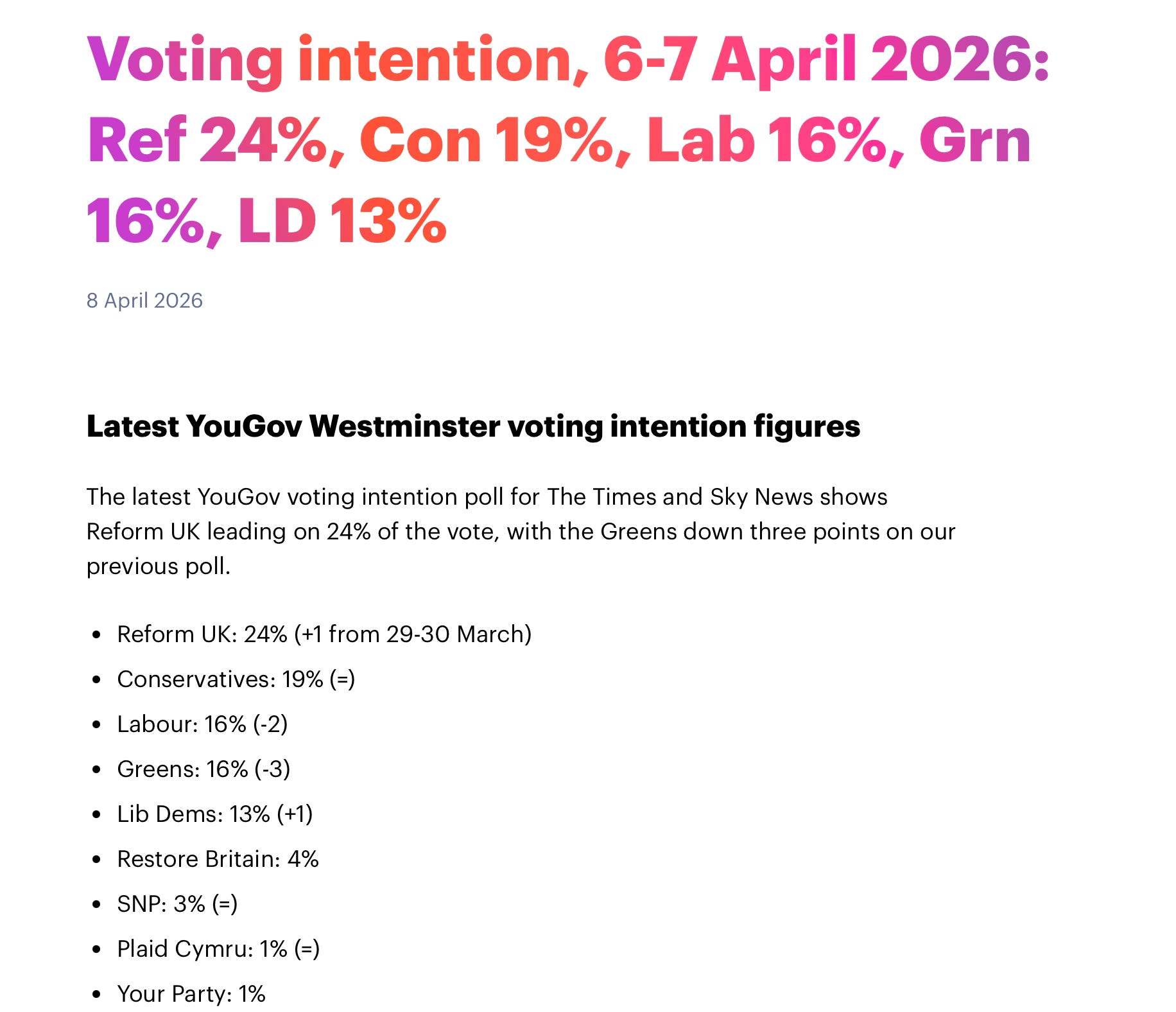
Then came the latest YouGov voting intention poll for The Times and Sky News, conducted on 6–7 April 2026, which put Restore Britain at just 4%.
Half the number from the party’s own polls. And unlike those, YouGov didn’t have a financial incentive to make Lowe look impressive. As the New Statesman bluntly noted, Restore Britain’s 4% “is a road to zero seats.”
Surge, you say? In the wrong direction, perhaps.
The Name Nobody Knows
Part of the problem is almost comically straightforward: most people in Britain have absolutely no idea who Rupert Lowe is.
Polling firm JL Partners found that fewer than one-in-ten British voters can identify Lowe, with his visibility having dropped from 14% to just 8% in the months after his expulsion from Reform UK. Among Reform UK voters themselves, 86% couldn’t name him when shown his picture.
To put that in perspective: 76% of voters correctly identified Nigel Farage, including 86% of 2024 Reform UK voters.
You cannot lead a democratic revolution if the public thinks you’re a bloke who might fix their boiler. Lowe has one MP — himself — and a heavy reliance on X (formerly Twitter), where, yes, he has a following. But X is not Britain. If it were, Elon Musk would be running the country. (He’s working on it, admittedly.)
Too Radical for the Mainstream — And Attracting Exactly The Wrong Crowd
Here is where it gets genuinely troubling, and where the polling decline starts to make uncomfortable sense.
Restore Britain has been described by numerous journalists and commentators as right-wing or far-right. Lowe himself has stated indifference to the party being described as far-right or racist, and has proclaimed that his party “will look at the facts, and then discriminate.” Which is quite a sentence for a man who wants to be taken seriously by mainstream Britain.
The policies themselves are extreme enough to give pause to ordinary right-of-centre voters. The party’s stated positions include large-scale deportation of people without legal status, a referendum on reinstating the death penalty, banning the burqa and niqab, abolishing kosher and halal slaughter, and withdrawing public funding from the BBC. There’s something in there to alienate almost everyone outside a very specific corner of the internet.
But it’s the company Restore Britain keeps that is truly damaging its prospects with anyone beyond the hard-right fringe.
Chris Mitchell, a former organiser for the antisemitic far-right group Patriotic Alternative and self-described “Nazi-Buddhist,” has been recruiting fellow ethno-nationalists to join Restore Britain since becoming a member of Great Yarmouth First — Restore Britain’s flagship local organisation. At an outdoor conference in mid-February, Mitchell posed for a selfie with Lowe and shared it on his Facebook page and Telegram channel. Mitchell claimed Lowe told him his extreme nationalist views were not a problem, calling it a matter of “free speech.” Lowe has not responded to requests to verify or deny this.
According to Hope Not Hate, the neo-Nazi Sam Wilkes has described Lowe as “a true hero” who is “normalising our talking points in parliament,” while the leadership of Patriotic Alternative has celebrated Lowe and Restore Britain.
And then there’s the American connection. Jared Taylor, founder of the neo-Nazi-aligned American Renaissance, announced on X that he had successfully joined Restore Britain — despite the fact he is banned from entering the UK due to his promotion of white supremacist views, having been excluded since 2015 with the Home Office describing his presence as “not conducive to the public good.” Taylor cheerfully boasted: “You can be a member even if you are banned from Britain, as I am!”
One might think a political party serious about winning elections would respond to this by immediately removing such a member and issuing a clear statement. Restore Britain’s response was... silence.
Hope Not Hate has concluded that ethnonationalists and neo-Nazis can view Restore Britain as a vehicle through which their talking points can be mainstreamed — and that Lowe faces a clear choice: reject the fascists decisively, or allow himself to be permanently associated with them.
He appears, so far, to have chosen the third option: pretending the question isn’t being asked.
The Respectable Right Takes Note — And Leaves
It’s telling that when Restore Britain formally registered as a political party, some of the more establishment-adjacent figures who had lent it credibility quietly headed for the door.
Following the formal party announcement, Susan Hall and Gavin Williamson — Conservative politicians who had been on Restore Britain’s advisory board — both left the organisation. You know things are going in a difficult direction when Gavin Williamson concludes the association is reputationally risky.
Even within the broader far-right ecosystem, there is fracture and mockery. One critic within that world described Lowe’s launch statement as sounding like “the lovechild of Thatcherite Conservatism and brain-dead populism,” adding that “Restore Britain is ideologically free market capitalism with racism. Like Thatcher on steroids.” That came not from a left-wing critic but from a rival far-right figure. The big tent is already leaking.
Ben Habib, leader of the rival Advance UK party, claimed publicly that Restore Britain had “gone full tilt racist” — an allegation that shook up the far-right ecosystem. He added that members of Restore Britain had been calling him a “p*ki.” This is not the kind of internal coalition-building that tends to produce electoral success.
What The Numbers Actually Tell Us
So what’s really happening here? The picture is fairly clear when you step back from the noise:
Restore Britain’s initial polling was inflated by methodology (hypothetical framing), self-commissioning (asking your own pollster to ask people about you), and the novelty factor of a new political entity. As independent, rigorous polling has kicked in, the numbers have corrected sharply downward.
The party’s support base, such as it is, is heavily concentrated among young men on social media, former non-voters, and — increasingly visibly — the far-right fringe. Hope Not Hate described the support base as “a fragile divide on the far right between civic nationalists on one side and ethnic nationalists on the other” — a coalition which could fracture at any time.
Meanwhile, the mainstream voters Lowe would need to become a serious political force are watching a man who poses for selfies with self-described Nazi-Buddhists, refuses to expel a US white supremacist banned from the UK, and claims that discriminating on the basis of facts is actually quite reasonable. Those voters are staying firmly with Reform UK — a party that, whatever its critics say, has spent considerable effort on brand management and distancing itself from open extremism.
The Bottom Line
Rupert Lowe launched Restore Britain with bombast, a 133-page deportation document, and the backing of Elon Musk. He told his followers they could win the next general election. The GB News crowd got very excited.
The first independent YouGov poll says: 4%.
That is not a surge. That is not a movement. That is a man who was booted out of one party for alleged bullying, started another party that became a magnet for neo-Nazis and banned American white supremacists, and is now discovering that “being extremely online” is not the same as “having a political future.”
Reform UK, meanwhile, sits at 24% in the same poll — leading every other party in the country.
As political stories go, “Restore Britain surging” turns out to be roughly as accurate as Rupert Lowe’s claim that dinghies were landing in Great Yarmouth — which transpired to be a group of volunteers rowing from Land’s End to John O’Groats to raise money for a motor neuron disease charity.
The “surge,” much like those boats, was never quite what it appeared to be.
Disclaimer: References to Hope Not Hate and other organisations within this article are made solely for journalistic and research purposes. Quoting or citing these sources does not constitute an endorsement of Hope Not Hate, their wider campaigns, political positions, or any other views they may hold. All sources have been used purely to illustrate polling trends and document publicly reported information.
Yes, you are right here. Although I like Restore's policies it hasn't got a hope in hell of winning a General Election and here's why.
In the 2024 General Election I stood for the SDP - it has an excellent policy agenda that I fully aligned with. The problem was that when out canvassing no-one had heard of the party or its leader William Clouston and there was also no money available for a widescale mailshot etc. As you say, Restore might be known to the internet polically savvy crowd but it will not register with those who are not. Also, its policies will only restrict it to a very specific group of voters.
The only party now with the nationwide profile to kick out the uniparty is Reform. It also has a financing model that will enable it to adequately finance the parliamentary candidates in the 2029 General Election.
Nigel Farage has a high political profile - he has been on the British political scene for a very long time - and I hope to see him occupying No. 10 and he and his Cabinet team getting our country back on track.
Few I actually know have ever heard of Rupert Lowe or Restore.